Showing posts with label humorous. Show all posts

Saturday, July 14, 2012

A Long Way from Chicago by Richard Peck


Having just finished a pretty heavy classic, I decided to find a quick, fun read.  Someone gave me a stack of Newbery Award books a while back, and since I remembered loving A Year Down Yonder by the same author, I chose this one.  Turns out that A Long Way from Chicago is the prequel to A Year Down Yonder, and it's every bit as entertaining.


With chapter headings such as, "Shotgun Cheatham's Last Night Above Ground," and "A One-Woman Crime Wave," you know you're not in for your run-of-the-mill coming-of-age novel.  Told from the perspective of a young boy, it chronicles the summer visits of Joey and his sister, Mary Alice, as they visit their eccentric, cranky, and very large grandma in her small town.  In each chapter, you get to watch the children grow up, but you also learn just a snippet more about Grandma. After each adventure you fall a bit more in love with her--her faults as well as her good qualities.

I would totally recommend these books for kids age nine or ten and up--real gems!

Tuesday, February 7, 2012

Great Expectations by Charles Dickens

It is Charles Dicken's 200th birthday today.  I get a lump in my throat just thinking about the impact this man has had on my life and the lives of millions of others over the past two centuries.  No writer has done more (Shakespeare excepted, perhaps) to influence everything from the way our novels are written to how we celebrate Christmas.  And no book, aside from the Book of Mormon, thrills my whole soul like a good Dickens novel.  I remember summer library trips in my youth, where I would bee-line straight to the "D" aisle of our library.  There I would touch the spines of those beautiful old Dickens books, deciding which one to immerse myself in next.

Great Expectations was my initiation into the rich parlance of Charles Dickens.  I remember reading it just after Jane Eyre and liking it, although I'm sure I didn't understand half of it.  It has everything--mystery, humor, a dash of romance--but I believe the most important theme of the book is the impact our choices have on us.

I especially enjoyed reading it with Lydia.  She surprised me one day by looking through the bookshelves in my room (my room is my sanctum sanctorum--it houses my Victorian novels, Harry Potter, and all the Barnes & Noble Classics I've accumulated) and stating her intention to read a Dickens.  "Don't get too excited, Mom," she stipulated, "or I probably won't do it."  (I made that mistake with Anne of Green Gables, and I fear she'll never give those gems a try . . . *sigh*)  She raced ahead of me--she can read like the wind, and she comprehends everything.  I was overjoyed to hear her laugh out loud at Mr. Wopsle & Mr. Pumblechook--she got it!  She discovered Dickens's masterful humor!  I felt like she'd finally joined my personal Dickens Fan Club.  Here are her thoughts--if nothing else, she's honest!


I liked Great Expectations.  The ending was different from the way I expected, but it was good overall.  There were some pretty interesting characters.  Wemmick was one of my favorites because of his funny double-life.  It taught a good lesson about thinking about what you choose, because Pip made lots of decisions, but not all of them were good.  He was kind of hasty at making choices.


I think Charles Dickens is a great author.  Great Expectations wasn't my style, but I think that's because I am a younger girl.  The older you are, the closer you are to that time period, so I'd suggest it to older people.


Yes, thank you, Lydia.  And if you're an "older person," as I obviously am, and closer in years to the 1800's, the story of Great Expectations is probably familiar to you, with its themes of crime, broken promises, and ambition.  I have to agree with Lyd--Pip has never been my favorite character (he seems so weak!), but his choices made for some of the best discussions we have ever shared about books.  I mean, haven't we all let someone down?  Haven't we all wanted to be popular, neglecting loved ones and dear friends in the process?  I'm glad we now have this great classic to fall back on as Lyd nears the teenage years--I can refer to Pip for examples of what not to do.  And there are so many redeeming characters--Joe, Biddy, Herbert, Wemmick--who somehow help make Pip become the man he should be.  We treasure the Biddies and Joes in our lives, don't we?

Dickens is beloved to me for another reason--he offers mutual ground for Seth and I.  While Seth barely tolerates my Jane Austen "chick flick-ish" movies, he hasn't met a Dickens movie he didn't like--or at least one that didn't keep him intrigued.  He actually grew up on this version of Great Expectations, thanks to my wonderful Mother-in-Law, Elaine:
It's fantastic (although I always had issues with Estella seeming so much older than Pip), produced by Disney, and starring the great Anthony Hopkins as Magwitch.  Point of interest:  Miss Havisham is Jean Simmons, who plays Estella in the 1946 version.

I haven't been too interested in any other version, especially the risque 1998 version (Dickens must have rolled over in his grave)--however, the BBC has made a new one (2011) that looks very intriguing.  I love what Gillian Anderson, the new Miss Havisham, has to say about her role in the film, as well as the book itself:


"I can imagine that journey [reading Great Expectations] as a young kid, especially a young boy, must be unbelievably exciting.
"It was the journey pre-Harry Potter. Of course it was longer ago, but I can imagine young people having the same kind of magical response to Great Expectations that we did when Harry Potter books first started to come out.
"That's if it does get introduced at an early age, in school or through a parent or whatever and the child is able to crack the density of it." http://www.bbc.co.uk/blogs/tv/2011/12/great-expectations-gillian-anderson.shtml

I may shy away from the even newer version (2012) with Helena Bonham Carter, bless her creepy heart, as Miss Havisham.  We'll have to see.

Seth marvels that I can enjoy new versions of shows I have seen so many times before, but I'd like to think Dickens would be proud that his stories are so timeless.  So go ahead--celebrate his birthday with a wonderful book or movie, and I guarantee you'll thank me.

Saturday, January 21, 2012

The 2 1/2 Pillars of Wisdom Series by Alexander McCall Smith (Portuguese Irregular Verbs)


Have you read The No. 1 Ladies' Detective Agency series yet?  You really must.  And then after you do (because I think it helps to fall head-over-heels-in-love with the brilliant Alexander McCall Smith first), you have to reserve a few short days to read this series, The 2 1/2 Pillars of Wisdom.  It includes Portuguese Irregular Verbs, The Finer Points of Sausage Dogs, and At the Villa of Reduced Circumstances.

Each book follows the mundane life of the socially awkward German professor, Dr. Moritz-Maria von Iglefeld, whose sole accomplishment was to publish Portuguese Irregular Verbs.  He finds himself in all kinds of embarrassing situations, although of course he is never to blame.

Although lacking the depth of the Ladies' Detective Agency series (McCall Smith is still at his best when writing from a woman's point of view), these are still absolutely brilliant.  The illustrations are simple, the stories quite ordinary, and the books very short (each one 120-ish pages).  They won't take up too much of your time, but are definitely worth every smile they put on your face.

Friday, July 1, 2011

Book review of Animal, Vegetable, Miracle by Barbara Kingsolver

The term "tree-hugger" has always carried a somewhat negative connotation for me--it brings to mind hippies living in tents or rallies to "save the spotted turtle!"  Forgive me if you are yourself a tree-hugger, but there you have it.  So I assumed that was what I was in for when our book club decided to read this.  Plus it's non-fiction, not my favorite category . . . but I was willing (reluctantly) to have a go--for Barbara Kingsolver's sake, since I loved her fascinating book, The Poisonwood Bible.

Would it be too trite to say this book changed my life?  Okay, maybe not quite that, but it has changed my thinking about food--probably forever, and I think for the better.  In the author's own words, here is the gist of the book:

"At its heart, a genuine food culture is an affinity between people and the land that feeds them.  Step one, probably, is to live on the land that feeds them, or at least on the same continent, ideally the same region.  Step two is to be able to countenance the ideas of 'food' and 'dirt' in the same sentence, and three is to start poking into one's supply chain and learn where things are coming from.  In the spirit of this adventure, our family set out to find ourselves a real American culture of food, or at least the piece of it that worked for us, and to describe it for anyone who might be looking for something similar.  This book tells the story of what we learned, or didn't; what we ate, or couldn't; and how our family was changed by one year of deliberately eating food produced in the same place where we worked, loved our neighbors, drank the water, and breathed the air.  It's not at all necessary to live on a food-producing farm to participate in this culture.  But it is necessary to know such farms exist, understand something about what they do, and consider oneself basically in their court.  This book is about those things." p. 20
Barbara Kingsolver literally takes you home with her--home to her family's little farm in Virginia, where she gives you a glimpse of their life during each month of this "locavore" (eating local & homegrown foods) experiment.  But she doesn't stop there.  She opens your eyes about the real dangers of the processed, industrial foods we are eating every day.  That is all fine and good, but what I loved the most was her emphasis on connecting with your family--on making mealtime a gathering time--both in eating and in meal preparation.  It rings true to me and reminds me of what Sister Julie Beck said recently about our families:

"Live in your home so that you’re brilliant in the basics, so that you’re intentional about your roles and responsibilities in the family. Think in terms of precision not perfection. If you have your goals and you are precise in how you go about them in your homes, youth will learn from you. They will learn that you pray, study the scriptures together, have family home evening, make a priority of mealtimes, and speak respectfully of your marriage partner. Then from your example the rising generation will gain great hope." (Julie B. Beck, "Teaching the Doctrine of the Family," Ensign, Mar. 2011, emphasis added)

Kingsolver speaks of the joys of holidays because of the food--and how that's not a bad thing, contrary to the popular dieting fads of today:

". . . [M]ost of America's excess pounds were not gained on national holidays.  After a certain age we can't make a habit of pie, certainly, but it's a soul-killing dogma that says we have to snub it even on Thanksgiving. . . . Planning complex, beautiful meals and investing one's heart and time in their preparation is the opposite of self-indulgence.  Kitchen-based family gatherings are process-oriented, cooperative, and in the best of worlds, nourishing and soulful.  A lot of calories get used up before anyone sits down to consume.  But more importantly, a lot of talk happens first, news exchanged, secrets revealed across generations, paths cleared with a touch on the arm.  I have given and received some of my life's most important hugs with those big oven-mitt potholders on both hands." p. 288

From a literary standpoint, Barbara Kingsolver has such a way with words!  She is like unto Alexander McCall Smith--you find that when you end one of her chapters, she has somehow come full-circle with its introduction. You'll have to give the book a try to see what I mean.  And if you'd rather just browse through her delicious recipes, check out the book's website.  Overall, I walked away from Animal, Vegetable, Miracle with renewed desire to make our family mealtime something special and purposeful.

Wednesday, May 11, 2011

Poetry by Douglas Florian

My kids and I stumbled upon a treasure--the poetry of Douglas Florian.  I confess I am not much of a poet enthusiast, and usually I don't understand much of it.  But children's poetry is another story--I remember spending hours devouring Shel Silverstein.  So I was delighted to discover Douglas Florian and his whimsical, playful style.  My kids memorized this one, they got such a kick out of it!  It's from Lizards, Frogs, and Polliwogs:


It's wise to stay clear
Of the dangerous cobra
All months of the year,
Including Octobra.


My personal favorite is "The Praying Mantis" from Insectlopedia:


Upon a twig
I sit and pray
For something big
To wend my way:
A caterpillar,
Moth,
Or bee--
I swallow them
Religiously.
His humorous artwork adds to each poem, and my kids like the fact that he paints with watercolor on paper bags.  Florian says this of his own work: "My drawings are abstract regressionist. They are old but behave like little children."  Apparently he has published several children's poetry books--can't wait to get my hands on them!

Thursday, April 21, 2011

Alice's Adventures in Wonderland & Through the Looking-Glass by Lewis Carroll

Jessica:  Having grown up watching Disney's cartoon version of Alice in Wonderland and now watching it with my own children, I have always had a soft spot in my heart for these stories.  I loved reading them as a pre-teen.  However, after watching the new Disney version by Tim Burton (it was very . . . interesting, to say the least), I had to re-read them to make sure they weren't more bizarre than I recalled.  They may be a bit off-the-wall, but not so outlandish as the movie would lead you to believe; in fact, both books were quite comical and had me laughing out loud.

Carroll was a master at language and logic--he actually worked as a mathematics tutor at Oxford, and you can tell that he had a brilliant mind.  He uses word play frequently in his stories, which makes them all the more amusing.  Both books are very clever and entertaining and well-deserving of the title "classics."

Alice's Adventures in Wonderland has the stories of the Mad Hatter & March Hare and the Queen of Hearts.  Through the Looking-Glass deals more with the chess pieces--the white and red queens--and traveling from one "square" of a giant chessboard to another. It includes the characters of Tweedle-dum and Tweedle-dee and the talking flowers.
Alice with Tweedle-Dum & Tweedle-Dee before their battle
Lydia:  I loved the royal subjects and how they acted. For example, how the Red Queen is running with Alice and they get absolutely nowhere. Then there is the White Queen who starts crying because she will get hurt in the future. I loved these books in every way!
Alice talking with the White Queen
(I suppose I am biased, but I love Lydia's drawing style!  I made her sketch a couple of her favorite scenes so I could show her off a bit . . . :)

Monday, April 11, 2011

Clarice Bean, the Utterly Complete Collection by Lauren Child

Lydia:  I thought this was a good book. It was about a little girl who wanted to be a mystery solver like the girl in her book--until she solves a mystery of her own. I really liked it because it was written by the same person who wrote Charlie & Lola. I also like the pictures. There are lots of them.  I love the way she describes things.

Jessica:  Lydia talked me into reading these books, and it didn't take much effort, since our entire family is in love with Lauren Child's Charlie & Lola series.  They were so entertaining!


Clarice Bean is a pre-teen girl growing up in England who deals with some very normal problems--a mean teacher, a pesky younger brother, and homework she doesn't want to do.  The whole series reminded me of the Ramona books by Beverly Cleary, which I loved when I was little.  These are for a slightly more mature audience than those, strictly for comprehension reasons.  Any pre-teens would really enjoy them.  They are clean, clever, and perfectly darling!  I found myself wanting to talk like Clarice, who is the author of these "diaries."  Listen to how delightful she is--for example, in describing the neighborhood organic grocery store:


It's all about selling things that haven't been sprayed with chemically things.
I am not sure what that word organic exactly stands for really.  Who does know?  They should call it "with bugs" or something so people know what they are in for.  You might find a caterpillar in your broccoli but that's the point.
Mom says, "There's nothing wrong with eating a caterpillar."
I say, "There is if you are vegetarian."


On the irritating boy who sits behind her in class:
And I can hear Robert Granger breathing.  That's what he does.  He sits behind me and breathes.  It drives me utterly crazy.
And I turn around and go, "Stop breathing, will you!"
And he says, "Clarice Bean, of course I cannot stop breathing because then I would be dead and how would you like that?"
I decide not to answer his question because Mom has taught me if you can't think of anything nice to say, then sometimes it is better to say nothing at all.  You see, I am trying really hard to keep it zipped in class.


Describing tofu:
. . . .[It] looks a bit like a very palish cheese but tastes of nothing.


The diary-like feel ("epistolary" form--am I not so smart?) keeps you reading just a bit more to see what Clarice will talk about next.  I don't know what to call it, but I love that she uses different font sizes and styles to emphasize words (reminds me of my wonderful sis-in-law, Chelsea, who does the same on her blog).  It's such a cute way of writing! 


Utterly Me, Clarice Bean is cute as can be, Clarice Bean Spells Trouble was my very favorite and had the best story line--very laughable throughout, and Clarice Bean, Don't Look Now was still great, although it dealt with more serious issues of divorce and moving, etc.  They are such quick reads--I think I read each one in a day.  I wish there were more of them!

Friday, February 18, 2011

Emma by Jane Austen

Before she began Emma, Jane Austen wrote, "I am going to take a heroine whom no one but myself will much like."
My husband completely agrees with that assessment of Emma Woodhouse--"She messes up everyone's life, but she still gets the guy in the end."  Still, I have to admit that I like Emma--not that I would want her as a best friend (poor Harriet Smith!).  I like that she has faults and weaknesses, but is determined to always make the best of things.  And she is a regular homebody, much like myself.


I have often wondered why I love Jane Austen as much as I do.  The plots of her novels are in no way thrilling, and there is, as Charlotte Bronte complained, "nothing vehement" in them.  Still she has a way of showing the weaknesses and strengths of her characters--they are so real.  Don't you know people like Mrs. Elton, always bragging and speaking of themselves?  Or someone cute and clueless like Harriet Smith?  And I'm not trying to brag, but I think I'm married to a definite Mr. Knightley (although Seth would cringe if I made that comparison out loud), who grounds me when I'm unreasonably upset or when I forget to think things through.  Just as with Dickens' characters, by reading about them, we can discover similar traits (both good and bad) in ourselves.


I love how George Henry Lewes ("friend" of George Eliot) describes Jane Austen:
"First and foremost let Austen be named, the greatest artist that has ever written, using the term to signify the most perfect mastery over the means to her end. There are heights and depths in human nature Miss Austen has never scaled nor fathomed, there are worlds of passionate existence into which she has never set foot; but although this is obvious to every reader, it is equally obvious that she has risked no failures by attempting to delineate that which she has not seen. Her circle may be restricted, but it is complete. Her world is a perfect orb, and vital. Life, as it presents itself to an English gentlewoman peacefully yet actively engaged in her quiet village, is mirrored in her works with a purity and fidelity that must endow them with interest for all time."


I won't bore you with plot details--doubtless most of you are familiar with the story of Emma.  If you choose to read it (and I strongly suggest you do!), I think you'll find it very entertaining.  I love the way the characters develop, particularly Emma.  By the end of the book you grow to--if not love her, at least to overlook her faults and to give her credit for trying hard to be good.

If you are too busy/lazy/unmotivated to read the book, then you must watch the movie.  My two favorite versions:
the 1996 adaptation featuring Gwyneth Paltrow and Jeremy Northam.  This version is short, more "Hollywood-ized," but also much more full of comedy.  It isn't as realistic, but I do love it--"I shall call you my Mr. Knightley."  When it came out I was in high school, and we all wanted to wear empire waists and do our hair like Emma's . . .


And much as I love that version, I might like this 2009 version slightly more . . . Romola Garai plays Emma, with Tommy Lee Miller as Mr. Knightley.  It follows the book very closely, and the characters seem less perfect and polished, but more like real people.  It's so good!  I think it's about 4 hours, so be prepared with a lot of time and a good bowl of popcorn.

Wednesday, December 8, 2010

A Christmas Carol by Charles Dickens

     I was excited to learn that our prophet, President Thomas S. Monson, and I have similar taste in books!  He addressed members of the Church of Jesus Christ of Latter-Day Saints last Sunday:
     "My Christmas reading each year helps bring to me the spirit of the season.  I always . . . read the timeless Dickens' classic; A Christmas Carol.  Who could fail to be inspired and taught by the changes which came to Ebeneezer Scrooge as he's instructed by the Ghosts of Christmas Past, Christmas Present, and Christmas Future?"  I know of no better way to kick off the Christmas season than with a reading of this beautiful story.  And I know you've probably seen all the movie versions a million times, but there is something so inspiring, so refreshing about this story that I strongly urge you to give the book a try.
     "Marley was dead, to begin with. . . . as dead as a doornail."  Beginning with a pun on doornails and coffin nails, Dickens perfectly mixes the spiritual with the macabre.  I read this every year to begin my holidays, and it never fails to bring a tear to my eye and make me resolve to be a little better.  I truly believe Dickens was inspired when he wrote it.
     The copy of A Christmas Carol I read this year had a fascinating introduction by a guy named Elliot Engel.  Do you have just a second?  You might find this interesting--we owe so much to Dickens' representation of Christmas:
     " . . . Dickens links snow and Christmas together for the first time in popular literature . . . before Dickens's story, the snow was merely mentioned by an author, never utilized to create that uniquely warm atmosphere which has become practically synonymous with our Christmas celebration today . . ."  
     What makes his description of a crisp, bright, snowy Christmas morning more surprising is that according to meteorologic records for England in the 1800's, "it snowed on Christmas Eve or Christmas Day in England on the average of only one time every thirty-two years."  However, Dickens' own childhood was unusual in that it was peppered with snowy white Christmases, due to a volcanic eruption in Indonesia (reminiscent of the Icelandic volcano eruption this year!) that changed weather patterns for a few years; he actually enjoyed a white Christmas at the impressionable ages of four, six, seven, and nine.
     I'm reading it to my little kids this year, and since they've watched the Muppet Christmas Carol and Mickey's Christmas Carol about fifty times already, they're quite interested (as long as I only read the "fun parts" and sing "There Goes Mr. Humbug" with them . . .).  It has given birth to some good discussions.

     So to quote Scrooge's nephew, Fred:
"There are many things from which I might have derived good, by which I have not profited, I dare say . . . Christmas among the rest.  But I am sure I have always thought of Christmas time, when it has come round -- apart from the veneration due to its sacred name and origin, if anything belonging to it can be apart from that -- as a good time: a kind, forgiving, charitable, pleasant time: the only time I know of, in the long calendar of the year, when men and women seem by one consent to open their shut-up hearts freely, and to think of people below them as if they really were fellow-passengers to the grave, and not another race of creatures bound on other journeys.  And therefore, uncle, though it has never put a scrap of gold or silver in my pocket, I believe that it has done me good, and will do me good; and I say, God bless it!"

Thursday, September 2, 2010

Our Hearts Were Young and Gay by Cornelia Otis Skinner

Light-hearted, hilarious, old-fashioned yet witty, this book is so much fun!  My grandma gave me her copy when I was in high school, and I have read it a few times whenever I needed a "'tweener"--something to read between hefty or intense novels.  More a travelogue than a story, it's the cheery tale of two 19-year-old girls on their first "independent" tour of Europe.  They encounter one mishap after another, from a shipwreck to spending a night (unwittingly) in a brothel--and it's all true!  I think it's the way Skinner puts things that makes it so entertaining.  (It reminds me of The Egg and I by Betty MacDonald, another delightful autobiography of sorts.) There is no underlying plot or "the moral of the story is . . ." but everyone once in a while it's nice to have a book like that, you know?

My copy looks like this (c. 1942):
. . . but apparently the newest version on Amazon (used for $7.50) is more like this.  Worth looking into!

Friday, May 28, 2010

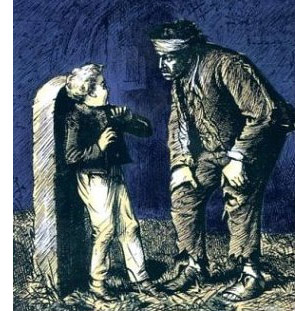
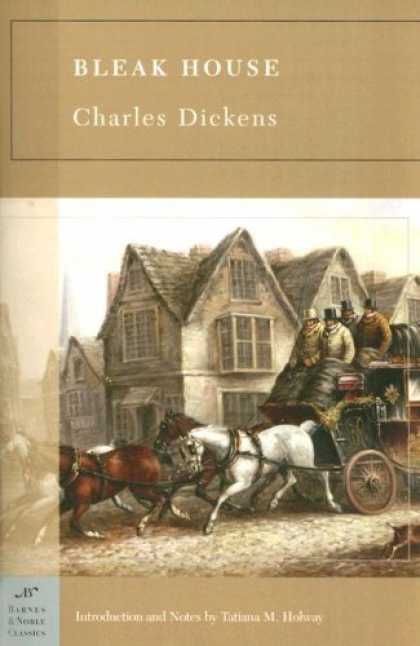
Bleak House by Charles Dickens


"What connexion can there have been between many people in the innumerable histories of this world, who, from opposite sides of great gulfs, have, nevertheless, been very curiously brought together!" (p. 220)
I have been reading Charles Dickens' books since long before I could fully appreciate them. Even though I didn't grasp the social commentary at a younger age, I have always loved the webs he weaves between and around his characters. By the end of each novel, everyone has had some influence on everyone else. The world seems a much smaller, more significant place after reading one of his works.

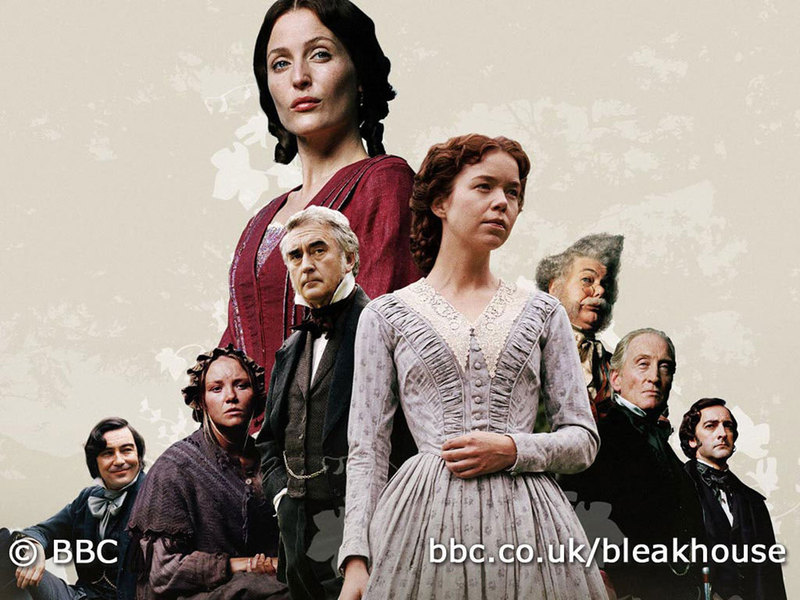
"His novels are full of energy and are teaming with life," says Andrew Davies, one of my favorite screenwriters (who incidentally did an incredible screen adaptation of this book) "I love the way he makes such a rich mixture of humour, tragedy, sentiment and social indignation. You get so many different things rolled up into one great book. He had such a vivid imagination and some of his characters are just extraordinary. Bleak House combines a terrific mystery with a series of love stores."
Dickens had a huge influence for good on society of the 1800's through his writing, and in this novel he focuses a great deal on the British Court of Chancery. Yet to me, the most interesting characters were those not directly involved with the "infamous" Chancery suit of Jarndyce and Jarndyce: I loved (and despised) Mrs. Jellyby, a woman intent on helping children a thousand miles away in Boorioboola-Gha, Africa, with several latch-key, unkempt children of her own. The married life of the sweet Bagnets, the "deportment" or Mr. Turveydrop, the awkward, muddling, good-hearted Mr. Guppy, and the poor street-sweep, Jo, were more interesting even than the main characters. This story is told from two completely different perspectives: chapters told by an all-knowing narrator who can see the end from the beginning (and drops several hints of it along the way), and the autobiographical chapters of Esther Summerson, the sweet and kind orphan girl who ends up blessing countless lives. His jumping back and forth between these two voices keeps the story interesting.

If you don't think you can handle the book (although you really should try!), you must at least watch the BBC version. Even those skeptical husbands out there (like my own) will like it for its mystery and suspense.

"The vast majority of the fastidious critics [of Dickens] have . . . never read Dickens at all; hence their opposition is due to and inspired by a hearty innocence which will certainly make them enthusiastic Dickensians if they ever, by some accident, happen to read him." -G. K. Chesterton

Sunday, May 9, 2010

The Help by Kathryn Stockett

I love reading a book that I'm sorry to finish.  Usually books that fall into that category are the classics, like a good Jane Austen or Charles Dickens.  In fact, it used to be that I didn't trust modern writers to come up with anything half as good.  But I absolutely loved this book, in spite of its being a national bestseller (and it looks like they're making it into a movie).  It's just about perfect for a book club (luckily that's how I was introduced; I don't often read books unless they come highly recommended by people I trust!).

Set in Jackson, Mississippi, in the midst of the Civil Rights movement, surrounded by Jim Crow laws, lynchings, and all kinds of racial issues, this novel explores the lives of two types of women; the white women of "society" and the black "help" they employ.  Stockett unfolds the experiences of three strong women; Skeeter Phelan, a white girl raised on a plantation, and Aibileen and Minny, two maids to her white friends.

Kathryn Stockett writes this book from three different and distinct viewpoints, reminiscent of Barbara Kingsolver's style in The Poisonwood Bible.  I couldn't pinpoint one I looked forward to hearing from the most--each had a lovable personality and faults a-plenty.  Perhaps that's what makes this story was so real and human.

I must warn you that it does have some swearing; not every-other-word or anything, but enough to discourage me from ever hearing it on tape . . . and there is a chapter with a "flasher" (I don't know how to put it more delicately) that I thought could have been left out.  But I still think it's a beautiful story well worth reading.

Thursday, May 6, 2010

The Incorrigible Children of Ashton Place: The Mysterious Howling by Maryrose Wood

"All books are judged by their covers until they are read."
Such is the claim of Agatha Swanburn, founder of the Swanburn Academy for Poor Bright Females. The prize student from this school, Miss Penelope Lumley, is the governess and heroine of the story, and often refers to such "pithy kernels of truth," another being, "If it were easy to resist, it would not be called chocolate cake."

I tend to judge books by their covers. Even more so, I judge them by their "opening act"--the first page usually has to grab my attention and delight me, and this book was a winner on both counts. The cover has a macabre look to it, and the story was delightful. A young governess is sent to instruct three "incorrigible" children (which incidentally becomes their last name) on how to behave--but unfortunately they appear to have been raised by wolves, making her task difficult and hilarious. It was a sort of Jane Eyre for kids--minus Mr. Rochester and the romance--written with a voice not unlike a modern Jane Austen:

"As you may have already had cause to discover, a statement can be both completely true and completely misleading at the same time. This is called 'selective truth telling,' and it is frequently used in political campaigns, toy advertisements, and other forms of propaganda." (p. 166)

"If you have ever opened a can of worms, boxed yourself into a corner, ended up in hot water, or found yourself in a pretty pickle, you already know that life is rarely (if ever) just a bowl of cherries. It is far more likely to be a bowl of problems, worries, and difficulties. This is normal and you should not be alarmed." (p. 119)

Clean, fun, witty (and even mildly instructive about literature and poetry), this book makes a good read for young adults and adults alike. It has a cliffhanger ending, which luckily means there are more to come!

Monday, March 8, 2010

The Tale of Despereaux by Kate DiCamillo

I loved this one! Thanks to Elsa for recommending it and Amy P. for letting me (without knowing it) borrow her beautiful copy. This only took a day to read, but it was so cleverly written and had very sweet symbolism. Perfect for a young reader--I can see why it became so popular! (And personally I think the book is better than the movie)
Part of what I liked about it was how the author talks to the reader--sort of Charlotte Bronte-ish--and addresses you as "Dear Reader" with some very charming insights into the story. Cute book! I really recommend it for young kids or for old ones looking for something quick and fun to read.


Friday, February 12, 2010

No. 1 Ladies Detective Agency by Alexander McCall Smith

If you haven't yet discovered this series, it's time you did. My wonderful Grandma Alma, who served two LDS missions to Africa, got me hooked on these books. Written (by a man, I might add!) from the perspective of Precious Ramotswe, a self-appointed female detective, they are set in Botswana, Africa.

What I love most about this series is the taste it gives you of every day life in Africa. From the beautiful style of speaking to the pumpkin soup and bush tea, each page contains little pearls of wisdom. The people are courteous (or at least expected to be so), life is slower, and there is a respect for humanity and nature that emanates from the pages. But it is far from boring! Each book has a key mystery to solve and several minor ones along the way, but you find yourself enjoying the culture and wisdom every bit as much as the mystery.

*Disclaimer: The very first book (and only the first--there are 10 all together) has a chunk in the middle that I remember being inappropriate--the only thing I've objected to in the whole series.


Here are all the books in the series (so far):

The No. 1 Ladies' Detective Agency
Tears of the Giraffe
Morality for Beautiful Girls
The Kalahari Typing School for Men
The Full Cupboard of Life
In the Company of Cheerful Ladies
Blue Shoes and Happiness
The Good Husband of Zebra Drive
The Miracle at Speedy Motors
Tea Time for the Traditionally Built
The Double Comfort Safari

How can you not love books with names like that?

The Guernsey Literary Potato Peel Pie Society by Mary Ann Shaffer & Annie Barrows

This is a very fun, entertaining, clean book. Sometimes it's nice to have a book like that--a "'tweener" to read in between heftier books. I found it very refreshing and hard to put down. It's an epistolary novel (aren't you proud of me for knowing that word?), which means it's written in letter form. Usually I'm not too keen on that type of book (Anne of Windy Poplars was the hardest of the Anne of Green Gables series for me to get through), but this one doesn't drag on like some.

Set in a little-known chunk of World War II history--the German occupation of Guernsey Island, off the coast of France--it contains a bit of mystery and romance--just enough to keep you turning pages. There is so much about World War II that is difficult to swallow, but this book focused on making the most of a difficult time, and perhaps that's why I enjoyed it so much. After all, isn't that what we are all aiming for?

Sunday, January 31, 2010

Charlie and the Chocolate Factory by Roald Dahl


This is one of my favorite books. It's about a boy (wait a second--doesn't everybody know this story?) named Charlie who finds a golden ticket and goes on a cool adventure in a giant chocolate factory.

The Twits by Roald Dahl


My class read this book together; it's about a man named Mr. Twit who has a huge beard and Mrs. Twit who has a glass eye. It has lots of silly stories about these very silly people.

Ginger Pie by Elenor Estes


I liked this book because it's about a dog who gets captured by a mysterious man in a yellow hat, but eventually finds it's owner. I think that this is a cute and funny book.
(Jessica here--I loved reading this book out loud to Lydia. There were many parts where we laughed out loud--it was truly darling. And clean and cute and old-fashioned--not enough books like that anymore!)

LinkWithin

Related Posts with Thumbnails