Showing posts with label book club. Show all posts

Tuesday, April 10, 2012

The Hunger Games Series by Suzanne Collins

It isn't every day that I am completely engrossed in a book.  I do my reading in snippets--a bit at the gym in the morning, some with my book propped up by a salt shaker while I eat lunch, etc.  Every once in a while I come across something I can't put down or read in bits and pieces.  With Harry Potter, I believe this was because the magical world J.K. Rowling created was so new and fascinating.  I can't think of anything since Harry Potter that has been so utterly gripping as The Hunger Games.


I was afraid to read these books--there is a lot of hype about them, and I have heard countless people tell me what they probably told you too: "The first one is great, the second is good too, but it doesn't end how you want it to . . . "  I have also been warned against the violence in the books.  And with good reason--these aren't stories for the faint of heart!


That said, I want to tell you why you should at least consider The Hunger Games series, if you haven't already read them like half of the reading world.


1. It's original. I mean, there are a lot of dystopian books out there, but none with such a believable, fascinating (albeit horrifying) premise.


2. The characters are believable.  No offense to the Twilight series, but Katniss is no Bella . . . I found myself really rooting for the main characters.

3. Yes, there was violence, but it wasn't the mindless killing I expected it to be. Katniss, the main character, regrets her part in any killing, and she makes a point of disagreeing with the entire Hunger Games. (I'm just assuming everyone knows the basic storyline here)


4. There was no mushy, inappropriate romance junk. I still wouldn't let anyone younger than 15-16 read it, just for the sake of the disturbing premise, but it was much more appropriate than the Twilight Books.  Ok, I'm afraid I'm going to get on my soapbox here for a minute . . .


Soapbox:  I am incredibly concerned about the youth of this decade being exposed to far too much intimacy through books like Twilight and the rest of that series.  They are so not appropriate for kids who are younger than . . . thirty, maybe?  Mostly the last one--far too much information about sexual matters.  And although they are written by a member of the same church I belong to, and even though the main characters are married--for heaven's sake, do we really need to know every private detail?  I believe books of this nature are porn in the form most tantalizing to young women.  Girls don't go around looking for pornography pictures; Satan knows he can snag women (young and old) through books and movies like Twilight.  I confess, I did read the series and watched the movies--the storyline is very interesting, but there is a real danger there you need to be aware of for young women.  Please be very careful with your young girls! Ok, I'm through.

5. Suzanne Collins can really write.  I think sometimes authors get in the way of their story--they write in an awkward way that never lets you forget you're reading a book.  In contrast, each one of these books draws you right in, and you're living the story with Katniss.  The first person voice isn't distracting at all, like others written in this style, and you forget you're reading.

6.  It provides very interesting food for discussion--is it possible for the world as we know it to become like Panem, this futuristic world?  What would you do if you were forced to join the Hunger Games?  Is war ever right?  You could have a great discussion with your kids about what type of government is really the best, as well as how the gospel of Jesus Christ can solve every social problem in the world.  I have heard the complaint that it doesn't teach a great moral lesson, but I beg to differ.

Now, about the individual books themselves: The Hunger Games could stand alone, if it weren't for the cliffhanger-ish ending.  It is powerful in and of itself, fascinating, and really well done.  Catching Fire is much the same, butI know people who have decided not to read Mockingjay because it's gotten a bad rap.  I submit that it is every bit as good as the other two books; while things don't end "happily ever after," the way Collins finishes it is absolutely brilliant, and she leaves you with a lot to mull over.

I have yet to see the movie, but I am very excited to give it a try.  I have heard good things.  So give the books a try if you are brave enough, and may the odds be ever in your favor!

Tuesday, February 7, 2012

Great Expectations by Charles Dickens

It is Charles Dicken's 200th birthday today.  I get a lump in my throat just thinking about the impact this man has had on my life and the lives of millions of others over the past two centuries.  No writer has done more (Shakespeare excepted, perhaps) to influence everything from the way our novels are written to how we celebrate Christmas.  And no book, aside from the Book of Mormon, thrills my whole soul like a good Dickens novel.  I remember summer library trips in my youth, where I would bee-line straight to the "D" aisle of our library.  There I would touch the spines of those beautiful old Dickens books, deciding which one to immerse myself in next.

Great Expectations was my initiation into the rich parlance of Charles Dickens.  I remember reading it just after Jane Eyre and liking it, although I'm sure I didn't understand half of it.  It has everything--mystery, humor, a dash of romance--but I believe the most important theme of the book is the impact our choices have on us.

I especially enjoyed reading it with Lydia.  She surprised me one day by looking through the bookshelves in my room (my room is my sanctum sanctorum--it houses my Victorian novels, Harry Potter, and all the Barnes & Noble Classics I've accumulated) and stating her intention to read a Dickens.  "Don't get too excited, Mom," she stipulated, "or I probably won't do it."  (I made that mistake with Anne of Green Gables, and I fear she'll never give those gems a try . . . *sigh*)  She raced ahead of me--she can read like the wind, and she comprehends everything.  I was overjoyed to hear her laugh out loud at Mr. Wopsle & Mr. Pumblechook--she got it!  She discovered Dickens's masterful humor!  I felt like she'd finally joined my personal Dickens Fan Club.  Here are her thoughts--if nothing else, she's honest!


I liked Great Expectations.  The ending was different from the way I expected, but it was good overall.  There were some pretty interesting characters.  Wemmick was one of my favorites because of his funny double-life.  It taught a good lesson about thinking about what you choose, because Pip made lots of decisions, but not all of them were good.  He was kind of hasty at making choices.


I think Charles Dickens is a great author.  Great Expectations wasn't my style, but I think that's because I am a younger girl.  The older you are, the closer you are to that time period, so I'd suggest it to older people.


Yes, thank you, Lydia.  And if you're an "older person," as I obviously am, and closer in years to the 1800's, the story of Great Expectations is probably familiar to you, with its themes of crime, broken promises, and ambition.  I have to agree with Lyd--Pip has never been my favorite character (he seems so weak!), but his choices made for some of the best discussions we have ever shared about books.  I mean, haven't we all let someone down?  Haven't we all wanted to be popular, neglecting loved ones and dear friends in the process?  I'm glad we now have this great classic to fall back on as Lyd nears the teenage years--I can refer to Pip for examples of what not to do.  And there are so many redeeming characters--Joe, Biddy, Herbert, Wemmick--who somehow help make Pip become the man he should be.  We treasure the Biddies and Joes in our lives, don't we?

Dickens is beloved to me for another reason--he offers mutual ground for Seth and I.  While Seth barely tolerates my Jane Austen "chick flick-ish" movies, he hasn't met a Dickens movie he didn't like--or at least one that didn't keep him intrigued.  He actually grew up on this version of Great Expectations, thanks to my wonderful Mother-in-Law, Elaine:
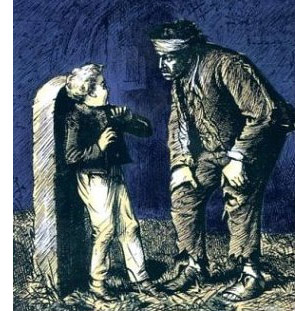
It's fantastic (although I always had issues with Estella seeming so much older than Pip), produced by Disney, and starring the great Anthony Hopkins as Magwitch.  Point of interest:  Miss Havisham is Jean Simmons, who plays Estella in the 1946 version.

I haven't been too interested in any other version, especially the risque 1998 version (Dickens must have rolled over in his grave)--however, the BBC has made a new one (2011) that looks very intriguing.  I love what Gillian Anderson, the new Miss Havisham, has to say about her role in the film, as well as the book itself:


"I can imagine that journey [reading Great Expectations] as a young kid, especially a young boy, must be unbelievably exciting.
"It was the journey pre-Harry Potter. Of course it was longer ago, but I can imagine young people having the same kind of magical response to Great Expectations that we did when Harry Potter books first started to come out.
"That's if it does get introduced at an early age, in school or through a parent or whatever and the child is able to crack the density of it." http://www.bbc.co.uk/blogs/tv/2011/12/great-expectations-gillian-anderson.shtml

I may shy away from the even newer version (2012) with Helena Bonham Carter, bless her creepy heart, as Miss Havisham.  We'll have to see.

Seth marvels that I can enjoy new versions of shows I have seen so many times before, but I'd like to think Dickens would be proud that his stories are so timeless.  So go ahead--celebrate his birthday with a wonderful book or movie, and I guarantee you'll thank me.

Saturday, January 21, 2012

The 2 1/2 Pillars of Wisdom Series by Alexander McCall Smith (Portuguese Irregular Verbs)


Have you read The No. 1 Ladies' Detective Agency series yet?  You really must.  And then after you do (because I think it helps to fall head-over-heels-in-love with the brilliant Alexander McCall Smith first), you have to reserve a few short days to read this series, The 2 1/2 Pillars of Wisdom.  It includes Portuguese Irregular Verbs, The Finer Points of Sausage Dogs, and At the Villa of Reduced Circumstances.

Each book follows the mundane life of the socially awkward German professor, Dr. Moritz-Maria von Iglefeld, whose sole accomplishment was to publish Portuguese Irregular Verbs.  He finds himself in all kinds of embarrassing situations, although of course he is never to blame.

Although lacking the depth of the Ladies' Detective Agency series (McCall Smith is still at his best when writing from a woman's point of view), these are still absolutely brilliant.  The illustrations are simple, the stories quite ordinary, and the books very short (each one 120-ish pages).  They won't take up too much of your time, but are definitely worth every smile they put on your face.

Friday, July 1, 2011

Book review of Animal, Vegetable, Miracle by Barbara Kingsolver

The term "tree-hugger" has always carried a somewhat negative connotation for me--it brings to mind hippies living in tents or rallies to "save the spotted turtle!"  Forgive me if you are yourself a tree-hugger, but there you have it.  So I assumed that was what I was in for when our book club decided to read this.  Plus it's non-fiction, not my favorite category . . . but I was willing (reluctantly) to have a go--for Barbara Kingsolver's sake, since I loved her fascinating book, The Poisonwood Bible.

Would it be too trite to say this book changed my life?  Okay, maybe not quite that, but it has changed my thinking about food--probably forever, and I think for the better.  In the author's own words, here is the gist of the book:

"At its heart, a genuine food culture is an affinity between people and the land that feeds them.  Step one, probably, is to live on the land that feeds them, or at least on the same continent, ideally the same region.  Step two is to be able to countenance the ideas of 'food' and 'dirt' in the same sentence, and three is to start poking into one's supply chain and learn where things are coming from.  In the spirit of this adventure, our family set out to find ourselves a real American culture of food, or at least the piece of it that worked for us, and to describe it for anyone who might be looking for something similar.  This book tells the story of what we learned, or didn't; what we ate, or couldn't; and how our family was changed by one year of deliberately eating food produced in the same place where we worked, loved our neighbors, drank the water, and breathed the air.  It's not at all necessary to live on a food-producing farm to participate in this culture.  But it is necessary to know such farms exist, understand something about what they do, and consider oneself basically in their court.  This book is about those things." p. 20
Barbara Kingsolver literally takes you home with her--home to her family's little farm in Virginia, where she gives you a glimpse of their life during each month of this "locavore" (eating local & homegrown foods) experiment.  But she doesn't stop there.  She opens your eyes about the real dangers of the processed, industrial foods we are eating every day.  That is all fine and good, but what I loved the most was her emphasis on connecting with your family--on making mealtime a gathering time--both in eating and in meal preparation.  It rings true to me and reminds me of what Sister Julie Beck said recently about our families:

"Live in your home so that you’re brilliant in the basics, so that you’re intentional about your roles and responsibilities in the family. Think in terms of precision not perfection. If you have your goals and you are precise in how you go about them in your homes, youth will learn from you. They will learn that you pray, study the scriptures together, have family home evening, make a priority of mealtimes, and speak respectfully of your marriage partner. Then from your example the rising generation will gain great hope." (Julie B. Beck, "Teaching the Doctrine of the Family," Ensign, Mar. 2011, emphasis added)

Kingsolver speaks of the joys of holidays because of the food--and how that's not a bad thing, contrary to the popular dieting fads of today:

". . . [M]ost of America's excess pounds were not gained on national holidays.  After a certain age we can't make a habit of pie, certainly, but it's a soul-killing dogma that says we have to snub it even on Thanksgiving. . . . Planning complex, beautiful meals and investing one's heart and time in their preparation is the opposite of self-indulgence.  Kitchen-based family gatherings are process-oriented, cooperative, and in the best of worlds, nourishing and soulful.  A lot of calories get used up before anyone sits down to consume.  But more importantly, a lot of talk happens first, news exchanged, secrets revealed across generations, paths cleared with a touch on the arm.  I have given and received some of my life's most important hugs with those big oven-mitt potholders on both hands." p. 288

From a literary standpoint, Barbara Kingsolver has such a way with words!  She is like unto Alexander McCall Smith--you find that when you end one of her chapters, she has somehow come full-circle with its introduction. You'll have to give the book a try to see what I mean.  And if you'd rather just browse through her delicious recipes, check out the book's website.  Overall, I walked away from Animal, Vegetable, Miracle with renewed desire to make our family mealtime something special and purposeful.

Friday, May 27, 2011

Founding Brothers: The Revolutionary Generation by Joseph J. Ellis


My good friend Jera brought this book over--somehow she ended up with two copies.  I can't think of the last time (if ever) I have read a whole book about our Founding Fathers, although I always have the best of intentions--I have a few of them on my "to-read" list on Goodreads . . . Since this one wasn't too thick (which is what usually scares me away from historical books or biographies), I decided to give it a try.  So glad I did--this one really got me thinking about our founding fathers and their contributions to the life we live today, as well as how far we have strayed as a nation from some of their original ideals.

Taking sort of a back-door approach, Ellis looks at some less-written-about episodes or aspects in the lives of Washington, Jefferson, Franklin, Adams, Madison, Hamilton, and Burr (i.e. unlikely friendships, Washington's farewell address, the duel between Hamilton & Burr) and uses them to paint a picture of what things must have really been like for these amazing men.  He does make a lot of assumptions, which troubled me at times, but he is a beautiful narrator; never once did I feel bored with it.  There were several moments during my reading when I was disenchanted with these great men, but just as I thought Ellis was going to knock them off my personal pedestal, he came full circle and restored my faith in their inspiration.  Well, maybe not Aaron Burr so much . . .

So yes, I would highly recommend it as a springboard to heftier historical or political reading. It has inspired me to attack John Adams by David McCullough.  Do you think I can handle it?

Monday, April 25, 2011

Jane Eyre by Charlotte Bronte

I have read Jane Eyre probably more than any book aside from the Book of Mormon and the New Testament. I love it so much, I worry that I won't do it justice!  It is definitely one of my top five all-time favorites.  It has been made into I don't know how many films, and even a Broadway play with a beautiful soundtrack.
I'm sure almost everyone is familiar with the story of Jane Eyre--plain, ordinary young lady becomes a governess and falls in love with her gruff employer . . . the plot seems fairly boring, but I LOVE IT!  And I know I'm not alone.  What exactly makes it so universally appealing?  


Well, here's what I love about Jane Eyre:
1. Jane herself tells the story, and she addresses you directly as "dear reader" several times, which pulls you in and makes you sympathize with her all the more.  You feel like you're a friend she's confiding in.
2. The love story is perhaps the most beautiful ever written--especially because it's between two such unlikely characters.  Neither is very alluring, per se, but their romance manifests a "marriage of true minds," as Shakespeare would say.
3. Mr. Rochester--he is just the perfect hero!  Actually not perfect--he has his flaws, but they make him that much more likeable.
4. It is just so well-written!  The dialogue is anything but dry or forced, and the narration flows so beautifully!
5.  Each character you become closely acquainted with is deep and passionate.
6. Perhaps what I like the most is that Jane isn't perfect.  She has a bit of a temper and is also tempted--but she has a firm conviction in what she knows is right.


There is so much food for discussion!  Jane's moral courage; Mr. Rochester's desire to begin a new life, yet falling into the same old habits; Jane's ability to rise above her surroundings and make the most of things--they just don't make books this cut and dried anymore!


Jane Eyre was even worthy of mention on this last General Conference--I was thrilled to hear Sister Ann M. Dibb say the following:  


One of my favorite books is the British classic Jane Eyre, (Hooray--we can be friends!) written by Charlotte Brontë and published in 1847. The main character, Jane Eyre, is a penniless, teenage orphan who exemplifies what it means to be true. In this fictional account, a man, Mr. Rochester, loves Miss Eyre but is unable to marry her. Instead, he begs Miss Eyre to live with him without the benefit of marriage. Miss Eyre loves Mr. Rochester as well, and for a moment she is tempted, asking herself, “Who in the world cares for you? or who will be injured by what you do?”


Quickly Jane’s conscience answers: “I care for myself. The more solitary, the more friendless, the more unsustained I am, the more I will respect myself. I will keep the law given by God. … Laws and principles are not for the times when there is no temptation: they are for such moments as this. … If at my individual convenience I might break them, what would be their worth? They have a worth—so I have always believed. … Preconceived opinions, foregone determinations, are all I have at this hour to stand by: there I plant my foot.”
In a desperate moment of temptation, Jane Eyre was true to her beliefs, she trusted in the law given by God, and she planted her foot in resistance to temptation.
Being true to our beliefs—even when doing so isn’t popular, easy, or fun—keeps us safely on the path that leads to eternal life with our Heavenly Father. ... Being true also allows us to have a positive effect on the lives of others. 
And that, I think, is what I like the most about Jane Eyre--the way her righteous choices influence the lives of others.
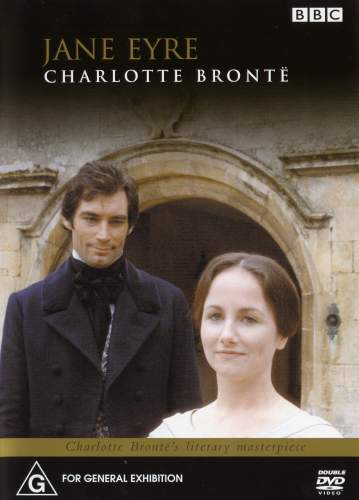
Now, I am quite partial to the movie versions of this wonderful classic, my favorites being the one starring Timothy Dalton
and the 2006 version starring Toby Stephens & Ruth Wilson.  I never get tired of watching this one--it is so well-done!
And, if you're as big a fan as I am, you will probably be eager to see the newly released 2011 version!  It looks good--a little dark and probably condensed to fit the typical 2-hour Hollywood length, but you really can't go too far wrong with Jane Eyre, can you?  
(Also, J.E. fans will enjoy this interesting comparison between the many movie-version Mr. Rochester's.)

Friday, February 18, 2011

Emma by Jane Austen

Before she began Emma, Jane Austen wrote, "I am going to take a heroine whom no one but myself will much like."
My husband completely agrees with that assessment of Emma Woodhouse--"She messes up everyone's life, but she still gets the guy in the end."  Still, I have to admit that I like Emma--not that I would want her as a best friend (poor Harriet Smith!).  I like that she has faults and weaknesses, but is determined to always make the best of things.  And she is a regular homebody, much like myself.


I have often wondered why I love Jane Austen as much as I do.  The plots of her novels are in no way thrilling, and there is, as Charlotte Bronte complained, "nothing vehement" in them.  Still she has a way of showing the weaknesses and strengths of her characters--they are so real.  Don't you know people like Mrs. Elton, always bragging and speaking of themselves?  Or someone cute and clueless like Harriet Smith?  And I'm not trying to brag, but I think I'm married to a definite Mr. Knightley (although Seth would cringe if I made that comparison out loud), who grounds me when I'm unreasonably upset or when I forget to think things through.  Just as with Dickens' characters, by reading about them, we can discover similar traits (both good and bad) in ourselves.


I love how George Henry Lewes ("friend" of George Eliot) describes Jane Austen:
"First and foremost let Austen be named, the greatest artist that has ever written, using the term to signify the most perfect mastery over the means to her end. There are heights and depths in human nature Miss Austen has never scaled nor fathomed, there are worlds of passionate existence into which she has never set foot; but although this is obvious to every reader, it is equally obvious that she has risked no failures by attempting to delineate that which she has not seen. Her circle may be restricted, but it is complete. Her world is a perfect orb, and vital. Life, as it presents itself to an English gentlewoman peacefully yet actively engaged in her quiet village, is mirrored in her works with a purity and fidelity that must endow them with interest for all time."


I won't bore you with plot details--doubtless most of you are familiar with the story of Emma.  If you choose to read it (and I strongly suggest you do!), I think you'll find it very entertaining.  I love the way the characters develop, particularly Emma.  By the end of the book you grow to--if not love her, at least to overlook her faults and to give her credit for trying hard to be good.

If you are too busy/lazy/unmotivated to read the book, then you must watch the movie.  My two favorite versions:
the 1996 adaptation featuring Gwyneth Paltrow and Jeremy Northam.  This version is short, more "Hollywood-ized," but also much more full of comedy.  It isn't as realistic, but I do love it--"I shall call you my Mr. Knightley."  When it came out I was in high school, and we all wanted to wear empire waists and do our hair like Emma's . . .


And much as I love that version, I might like this 2009 version slightly more . . . Romola Garai plays Emma, with Tommy Lee Miller as Mr. Knightley.  It follows the book very closely, and the characters seem less perfect and polished, but more like real people.  It's so good!  I think it's about 4 hours, so be prepared with a lot of time and a good bowl of popcorn.

Friday, January 14, 2011

Tess of the D'urbervilles by Thomas Hardy

You have to prepare yourself if you're going to read this one.  I'm going to spoil everything for you and tell you that yes, it is a tragedy, and no, it doesn't end well (which is, I suppose, the definition of tragedy . . . ).  But somehow knowing that at the outset helped me, because I just had to keep reading to find out what would happen and how much worse it could get.   I could hardly put it down--and I'm afraid I ended up absolutely loving it!  And of course being completely frustrated with half the characters . . . I could actually sympathize with my husband's complaints of the lack of communication skills in my British movies.  I don't think I'll be showing him this one.

Like Dickens, I can see why Hardy felt compelled to write about the social ills of his day.  And like Dickens, I have to admit that Thomas Hardy is a wonderful author.  He gets into the minds of the characters so thoroughly--the hardest thing for me was that he kept saying, "Had he said such-and-such, she never would have etc. etc. etc."  All the more tragic!  I admit that I wept for Tess more than once (and once at the gym--why do I always hit the sad parts while I'm exercising?).  Although this book was originally met with outrage, I thought it taught a very poignant lesson about purity, chastity, and respect for women--one that at the time was much-needed and is probably needed even more today.

Sunday, December 19, 2010

Little Women by Louisa May Alcott

I've found the perfect book for you to start right now.  You've probably already read it (if your a female and belong to my generation or older) or at least heard of it, but isn't it nice sometimes to be reminded of great books?


And this truly is a great one--a healing book, as Oliver Van DeMille would say--one that is not only entertaining, but also beautiful and full of little pearls of wisdom--it makes you want to be better.

Little Women is a true American classic.  Set in Civil War New England, it narrates several years in the lives of the March sisters--Meg, Jo, Beth and Amy.  It begins right at Christmas time, which makes it an ideal book to start right now, then to keep reading throughout the new year.  It's very inspiring.  I used to want to be like Meg--beautiful, sweet and motherly, and while I enjoy reading about her experiences as a new wife and mother, Marmee is my real hero.  Now that I have my own kids, I treasure her wisdom and want to emulate the love (and PATIENCE!) she shows her own children.  Take this little tidbit, for example:

"'[Your father] showed me that I must try to practice all the virtues I would have my little girls possess, for I was their example. . . . the love, respect and confidence of my children was the sweetest reward I could receive for my efforts to be the woman I would have them copy.'"

I love this parenting advice:
"Mrs. March knew that experience was an excellent teacher, and when it was possible she left her children to learn alone the lessons which she would gladly have made easier, if they had not objected to taking advice . . ."

And talking with Jo:
"'If I don't seem to need help, it is because I have a better friend, even than Father, to comfort and sustain me.  My child, the troubles and temptations of your life are beginning and may be many, but you can overcome and outlive them all if you learn to feel the strength and tenderness of your Heavenly Father as you do your earthly one.'"

You just don't hear things like that in books anymore--they would be considered too moralistic, too religious. But how beautiful and true they are!  And if there is anything virtuous, lovely, or praiseworthy, shouldn't we seek after these things?  I think all daughters should be encouraged to read this book--all mothers too.  Why not at the same time?  Talk about what you read and the chocies the sisters make.  It may be old-fashioned, but the principles are every bit as important now!

Wednesday, December 8, 2010

A Christmas Carol by Charles Dickens

     I was excited to learn that our prophet, President Thomas S. Monson, and I have similar taste in books!  He addressed members of the Church of Jesus Christ of Latter-Day Saints last Sunday:
     "My Christmas reading each year helps bring to me the spirit of the season.  I always . . . read the timeless Dickens' classic; A Christmas Carol.  Who could fail to be inspired and taught by the changes which came to Ebeneezer Scrooge as he's instructed by the Ghosts of Christmas Past, Christmas Present, and Christmas Future?"  I know of no better way to kick off the Christmas season than with a reading of this beautiful story.  And I know you've probably seen all the movie versions a million times, but there is something so inspiring, so refreshing about this story that I strongly urge you to give the book a try.
     "Marley was dead, to begin with. . . . as dead as a doornail."  Beginning with a pun on doornails and coffin nails, Dickens perfectly mixes the spiritual with the macabre.  I read this every year to begin my holidays, and it never fails to bring a tear to my eye and make me resolve to be a little better.  I truly believe Dickens was inspired when he wrote it.
     The copy of A Christmas Carol I read this year had a fascinating introduction by a guy named Elliot Engel.  Do you have just a second?  You might find this interesting--we owe so much to Dickens' representation of Christmas:
     " . . . Dickens links snow and Christmas together for the first time in popular literature . . . before Dickens's story, the snow was merely mentioned by an author, never utilized to create that uniquely warm atmosphere which has become practically synonymous with our Christmas celebration today . . ."  
     What makes his description of a crisp, bright, snowy Christmas morning more surprising is that according to meteorologic records for England in the 1800's, "it snowed on Christmas Eve or Christmas Day in England on the average of only one time every thirty-two years."  However, Dickens' own childhood was unusual in that it was peppered with snowy white Christmases, due to a volcanic eruption in Indonesia (reminiscent of the Icelandic volcano eruption this year!) that changed weather patterns for a few years; he actually enjoyed a white Christmas at the impressionable ages of four, six, seven, and nine.
     I'm reading it to my little kids this year, and since they've watched the Muppet Christmas Carol and Mickey's Christmas Carol about fifty times already, they're quite interested (as long as I only read the "fun parts" and sing "There Goes Mr. Humbug" with them . . .).  It has given birth to some good discussions.

     So to quote Scrooge's nephew, Fred:
"There are many things from which I might have derived good, by which I have not profited, I dare say . . . Christmas among the rest.  But I am sure I have always thought of Christmas time, when it has come round -- apart from the veneration due to its sacred name and origin, if anything belonging to it can be apart from that -- as a good time: a kind, forgiving, charitable, pleasant time: the only time I know of, in the long calendar of the year, when men and women seem by one consent to open their shut-up hearts freely, and to think of people below them as if they really were fellow-passengers to the grave, and not another race of creatures bound on other journeys.  And therefore, uncle, though it has never put a scrap of gold or silver in my pocket, I believe that it has done me good, and will do me good; and I say, God bless it!"

Thursday, September 30, 2010

Gilead by Marilynne Robinson

We are reading this book for our book club, and I admit I wasn't very excited about it.  The name sounded quite forbidding and sermonizing somehow, and as I thumbed through the pages, I saw little or no dialogue.  But since it is a Pulitzer Prize winner, I thought I'd better give it a sporting chance.


And I am so glad I did!  Both reflective and inspiring, but with a good story line (yes, it does have a story, even without the dialogue!) it wasn't preachy like I suspected.  Ironically enough, it is the fictional autobiography of a preacher in Gilead, Iowa, nearing the end of his life.  As he writes to the son who will not remember him, he discovers that even in old age there is much to learn.  It is so beautifully written!  Marilynne Robinson's writing style kept reminding me of C.S. Lewis in his more serious books (i.e. Mere Christianity, etc.).  No swearing that I can recall, and nothing inappropriate or risqué.


It was one of those books that made me contemplate how I treat others and what I judge them by.  It seemed to go right along with our prophet's words from the General Relief society meeting last weekend:


"Mother Teresa, a Catholic nun who worked among the poor in India most of her life, spoke this profound truth: 'If you judge people, you have no time to love them.' . . . I ask: can we love one another, as the Savior has commanded, if we judge each other? And I answer—with Mother Teresa: no, we cannot. . . .I have in mind the charity that impels us to be sympathetic, compassionate, and merciful, not only in times of sickness and affliction and distress but also in times of weakness or error on the part of others."


I hope you find time to read and enjoy this one!  And  Pres. Monson's talk too, if you have the chance!

Wednesday, June 9, 2010

Roots by Alex Haley

"It begins with a birth in 1750, in an African village; it ends seven generations later at the Arkansas funeral of a black professor whose children are a teacher, a Navy architect, an assistant director of the U.S. Information Agency, and an author. The author is Alex Haley. This magnificent book is his."

So states the back cover write-up of this magnificent book--doesn't it just give you the chills?My good friend Taryn, when I told her I hadn't read it before, told me I simply had to read it. I had seen the TV series with I was little and remembered it as being quite troubling. But I think it deserves to be read.

As I read it, I thought so much of my own family history, of our nation's history, of resiliency of the human soul, and of the human need to pass on to our children the things that we know. After so much struggle, heartache, love, and perseverance, when I read the final chapter of the book where the author himself comes into the story, I couldn't hold back the tears. Life is truly beautiful!

*Disclaimer: You should know (and probably do) that this book deals quite graphically with slavery and all its horrors. There are brutal beatings and wicked slave masters . . . I won't go on, but there were a couple of parts I skimmed over. Yet I still feel it is such an important book that it's worth reading--if it wasn't, I probably wouldn't have posted it!

Sunday, May 9, 2010

The Help by Kathryn Stockett

I love reading a book that I'm sorry to finish.  Usually books that fall into that category are the classics, like a good Jane Austen or Charles Dickens.  In fact, it used to be that I didn't trust modern writers to come up with anything half as good.  But I absolutely loved this book, in spite of its being a national bestseller (and it looks like they're making it into a movie).  It's just about perfect for a book club (luckily that's how I was introduced; I don't often read books unless they come highly recommended by people I trust!).

Set in Jackson, Mississippi, in the midst of the Civil Rights movement, surrounded by Jim Crow laws, lynchings, and all kinds of racial issues, this novel explores the lives of two types of women; the white women of "society" and the black "help" they employ.  Stockett unfolds the experiences of three strong women; Skeeter Phelan, a white girl raised on a plantation, and Aibileen and Minny, two maids to her white friends.

Kathryn Stockett writes this book from three different and distinct viewpoints, reminiscent of Barbara Kingsolver's style in The Poisonwood Bible.  I couldn't pinpoint one I looked forward to hearing from the most--each had a lovable personality and faults a-plenty.  Perhaps that's what makes this story was so real and human.

I must warn you that it does have some swearing; not every-other-word or anything, but enough to discourage me from ever hearing it on tape . . . and there is a chapter with a "flasher" (I don't know how to put it more delicately) that I thought could have been left out.  But I still think it's a beautiful story well worth reading.

Friday, April 23, 2010

Sarah's Quilt by Nancy E Turner


A sequel to These is My Words by Nancy E. Turner, Sarah's Quilt had so much that I loved in it. It changes the way you look at our easy life nowadays, as the main character goes through drought and loss of cattle, land, etc. If you have read and enjoyed the first book, I'm sure you'll like this one. I did think it was a bit unrealistic that so many major things happen in such a short amount of time, but it's still believable and very interesting to read. I can't decide if I liked this or the first one better; in the second, Sarah Prine has been through so much and has become an amazingly strong woman, but I think I liked her better young, bold, and naive. Still, this one was clean, and you can't argue with that! (If you're interested, here's a good review of the series.)

Wednesday, March 31, 2010

How Green Was My Valley by Richard Llewellyn

From the very first page of this book, I was gripped by the beautiful Welsh voice of the narrator--you find yourself thinking with a lilt.  The whole book just felt green.  I don't mean eco-friendly green--just lush and beautiful, like the fields of England I miss so much.


The narrator, Huw Morgan (never quite sure how to pronounce that . . . Hugh? How? . . .), reflects on his life, beginning with his childhood.  Even though they go through trial after trial, their simple faith and strength are inspiring.   I almost felt it could be the tale of my own ancestors.
***Disclaimer: I hate how some of the best books have to have these!  In the "coming-of-age" portion of Huw's life, he gets way too involved with a young lady.  I skipped several paragraphs, so I honestly don't know exactly how graphic it was, but what I read was too much for me.  The only dog poop in the cinnamon roll, as my mother would say . . . still, I think the rest of the book is well worth reading if you are forewarned, and now you have been.

Monday, March 8, 2010

The Tale of Despereaux by Kate DiCamillo

I loved this one! Thanks to Elsa for recommending it and Amy P. for letting me (without knowing it) borrow her beautiful copy. This only took a day to read, but it was so cleverly written and had very sweet symbolism. Perfect for a young reader--I can see why it became so popular! (And personally I think the book is better than the movie)
Part of what I liked about it was how the author talks to the reader--sort of Charlotte Bronte-ish--and addresses you as "Dear Reader" with some very charming insights into the story. Cute book! I really recommend it for young kids or for old ones looking for something quick and fun to read.


Monday, March 1, 2010

These is My Words by Nancy E. Turner

Another epistolary novel, this book is set in Arizona territory back in the 1800's. It has a realistic feel to it--it covers everything from the pioneer treks across the country to the first blood transfusions and hospitals. Set in a believable diary form, you really felt like you were watching Sarah Agnes Prine grow up. She begins her journey traveling in a wagon train (where she even meets up with some Mormon pioneers, among others) and ends . . .
No, I won't ruin it for you--besides, a description of just the story line doesn't quite do it justice--instead you have to read it, and you'll find yourself caught up in the life of this brave, believable pioneer woman. It made me really think about every day life back then and what my ancestors went through. Thanks to Jera & Amy for recommending this book!
*Disclaimer: There are some wild-west-ish parts that are a bit racy--one at the beginning and another mid-way through the book. Also a bit too much about the intimate life of the main characters, so be forewarned. I skipped them--they probably weren't too bad, but I'd rather skip parts than have them in my head! :) Hopefully you feel the same way.

Wednesday, February 17, 2010

Book Review of The Poisonwood Bible by Barbara Kingsolver


I was surprised by how much I loved this book. A missionary family (a controlling, bible-thumping minister, his wife and four daughters) embarks on a journey deep into the heart of the Congo. Beautifully written, Kingsolver uses the very distinct voices of each daughter to tell the story of their experiences. The entire novel is almost poetic, and although there were parts I didn't love (some of the end gets a bit slow), I found myself anxious to see what the next chapter would contain. I've never read a book so tapestry-like, with each chapter as a thread. We read this for our book club, and I think it's a great novel for that type of setting.

LinkWithin

Related Posts with Thumbnails