Showing posts with label mystery. Show all posts

Tuesday, February 7, 2012

Great Expectations by Charles Dickens

It is Charles Dicken's 200th birthday today.  I get a lump in my throat just thinking about the impact this man has had on my life and the lives of millions of others over the past two centuries.  No writer has done more (Shakespeare excepted, perhaps) to influence everything from the way our novels are written to how we celebrate Christmas.  And no book, aside from the Book of Mormon, thrills my whole soul like a good Dickens novel.  I remember summer library trips in my youth, where I would bee-line straight to the "D" aisle of our library.  There I would touch the spines of those beautiful old Dickens books, deciding which one to immerse myself in next.

Great Expectations was my initiation into the rich parlance of Charles Dickens.  I remember reading it just after Jane Eyre and liking it, although I'm sure I didn't understand half of it.  It has everything--mystery, humor, a dash of romance--but I believe the most important theme of the book is the impact our choices have on us.

I especially enjoyed reading it with Lydia.  She surprised me one day by looking through the bookshelves in my room (my room is my sanctum sanctorum--it houses my Victorian novels, Harry Potter, and all the Barnes & Noble Classics I've accumulated) and stating her intention to read a Dickens.  "Don't get too excited, Mom," she stipulated, "or I probably won't do it."  (I made that mistake with Anne of Green Gables, and I fear she'll never give those gems a try . . . *sigh*)  She raced ahead of me--she can read like the wind, and she comprehends everything.  I was overjoyed to hear her laugh out loud at Mr. Wopsle & Mr. Pumblechook--she got it!  She discovered Dickens's masterful humor!  I felt like she'd finally joined my personal Dickens Fan Club.  Here are her thoughts--if nothing else, she's honest!


I liked Great Expectations.  The ending was different from the way I expected, but it was good overall.  There were some pretty interesting characters.  Wemmick was one of my favorites because of his funny double-life.  It taught a good lesson about thinking about what you choose, because Pip made lots of decisions, but not all of them were good.  He was kind of hasty at making choices.


I think Charles Dickens is a great author.  Great Expectations wasn't my style, but I think that's because I am a younger girl.  The older you are, the closer you are to that time period, so I'd suggest it to older people.


Yes, thank you, Lydia.  And if you're an "older person," as I obviously am, and closer in years to the 1800's, the story of Great Expectations is probably familiar to you, with its themes of crime, broken promises, and ambition.  I have to agree with Lyd--Pip has never been my favorite character (he seems so weak!), but his choices made for some of the best discussions we have ever shared about books.  I mean, haven't we all let someone down?  Haven't we all wanted to be popular, neglecting loved ones and dear friends in the process?  I'm glad we now have this great classic to fall back on as Lyd nears the teenage years--I can refer to Pip for examples of what not to do.  And there are so many redeeming characters--Joe, Biddy, Herbert, Wemmick--who somehow help make Pip become the man he should be.  We treasure the Biddies and Joes in our lives, don't we?

Dickens is beloved to me for another reason--he offers mutual ground for Seth and I.  While Seth barely tolerates my Jane Austen "chick flick-ish" movies, he hasn't met a Dickens movie he didn't like--or at least one that didn't keep him intrigued.  He actually grew up on this version of Great Expectations, thanks to my wonderful Mother-in-Law, Elaine:
It's fantastic (although I always had issues with Estella seeming so much older than Pip), produced by Disney, and starring the great Anthony Hopkins as Magwitch.  Point of interest:  Miss Havisham is Jean Simmons, who plays Estella in the 1946 version.

I haven't been too interested in any other version, especially the risque 1998 version (Dickens must have rolled over in his grave)--however, the BBC has made a new one (2011) that looks very intriguing.  I love what Gillian Anderson, the new Miss Havisham, has to say about her role in the film, as well as the book itself:


"I can imagine that journey [reading Great Expectations] as a young kid, especially a young boy, must be unbelievably exciting.
"It was the journey pre-Harry Potter. Of course it was longer ago, but I can imagine young people having the same kind of magical response to Great Expectations that we did when Harry Potter books first started to come out.
"That's if it does get introduced at an early age, in school or through a parent or whatever and the child is able to crack the density of it." http://www.bbc.co.uk/blogs/tv/2011/12/great-expectations-gillian-anderson.shtml

I may shy away from the even newer version (2012) with Helena Bonham Carter, bless her creepy heart, as Miss Havisham.  We'll have to see.

Seth marvels that I can enjoy new versions of shows I have seen so many times before, but I'd like to think Dickens would be proud that his stories are so timeless.  So go ahead--celebrate his birthday with a wonderful book or movie, and I guarantee you'll thank me.

Thursday, June 16, 2011

The Magic Thief Series by Sarah Prineas


          I absolutely loved this book!  It had plenty of mystery, fantasy, and adventure.  It's kind of like Harry Potter, in the way that it has magic and wizards--just no wands.  I liked the way the author described everything. It's one of my favorites.

Monday, April 25, 2011

Jane Eyre by Charlotte Bronte

I have read Jane Eyre probably more than any book aside from the Book of Mormon and the New Testament. I love it so much, I worry that I won't do it justice!  It is definitely one of my top five all-time favorites.  It has been made into I don't know how many films, and even a Broadway play with a beautiful soundtrack.
I'm sure almost everyone is familiar with the story of Jane Eyre--plain, ordinary young lady becomes a governess and falls in love with her gruff employer . . . the plot seems fairly boring, but I LOVE IT!  And I know I'm not alone.  What exactly makes it so universally appealing?  


Well, here's what I love about Jane Eyre:
1. Jane herself tells the story, and she addresses you directly as "dear reader" several times, which pulls you in and makes you sympathize with her all the more.  You feel like you're a friend she's confiding in.
2. The love story is perhaps the most beautiful ever written--especially because it's between two such unlikely characters.  Neither is very alluring, per se, but their romance manifests a "marriage of true minds," as Shakespeare would say.
3. Mr. Rochester--he is just the perfect hero!  Actually not perfect--he has his flaws, but they make him that much more likeable.
4. It is just so well-written!  The dialogue is anything but dry or forced, and the narration flows so beautifully!
5.  Each character you become closely acquainted with is deep and passionate.
6. Perhaps what I like the most is that Jane isn't perfect.  She has a bit of a temper and is also tempted--but she has a firm conviction in what she knows is right.


There is so much food for discussion!  Jane's moral courage; Mr. Rochester's desire to begin a new life, yet falling into the same old habits; Jane's ability to rise above her surroundings and make the most of things--they just don't make books this cut and dried anymore!


Jane Eyre was even worthy of mention on this last General Conference--I was thrilled to hear Sister Ann M. Dibb say the following:  


One of my favorite books is the British classic Jane Eyre, (Hooray--we can be friends!) written by Charlotte Brontë and published in 1847. The main character, Jane Eyre, is a penniless, teenage orphan who exemplifies what it means to be true. In this fictional account, a man, Mr. Rochester, loves Miss Eyre but is unable to marry her. Instead, he begs Miss Eyre to live with him without the benefit of marriage. Miss Eyre loves Mr. Rochester as well, and for a moment she is tempted, asking herself, “Who in the world cares for you? or who will be injured by what you do?”


Quickly Jane’s conscience answers: “I care for myself. The more solitary, the more friendless, the more unsustained I am, the more I will respect myself. I will keep the law given by God. … Laws and principles are not for the times when there is no temptation: they are for such moments as this. … If at my individual convenience I might break them, what would be their worth? They have a worth—so I have always believed. … Preconceived opinions, foregone determinations, are all I have at this hour to stand by: there I plant my foot.”
In a desperate moment of temptation, Jane Eyre was true to her beliefs, she trusted in the law given by God, and she planted her foot in resistance to temptation.
Being true to our beliefs—even when doing so isn’t popular, easy, or fun—keeps us safely on the path that leads to eternal life with our Heavenly Father. ... Being true also allows us to have a positive effect on the lives of others. 
And that, I think, is what I like the most about Jane Eyre--the way her righteous choices influence the lives of others.
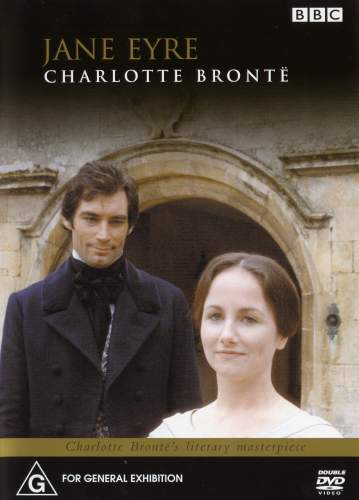
Now, I am quite partial to the movie versions of this wonderful classic, my favorites being the one starring Timothy Dalton
and the 2006 version starring Toby Stephens & Ruth Wilson.  I never get tired of watching this one--it is so well-done!
And, if you're as big a fan as I am, you will probably be eager to see the newly released 2011 version!  It looks good--a little dark and probably condensed to fit the typical 2-hour Hollywood length, but you really can't go too far wrong with Jane Eyre, can you?  
(Also, J.E. fans will enjoy this interesting comparison between the many movie-version Mr. Rochester's.)

Monday, April 11, 2011

Clarice Bean, the Utterly Complete Collection by Lauren Child

Lydia:  I thought this was a good book. It was about a little girl who wanted to be a mystery solver like the girl in her book--until she solves a mystery of her own. I really liked it because it was written by the same person who wrote Charlie & Lola. I also like the pictures. There are lots of them.  I love the way she describes things.

Jessica:  Lydia talked me into reading these books, and it didn't take much effort, since our entire family is in love with Lauren Child's Charlie & Lola series.  They were so entertaining!


Clarice Bean is a pre-teen girl growing up in England who deals with some very normal problems--a mean teacher, a pesky younger brother, and homework she doesn't want to do.  The whole series reminded me of the Ramona books by Beverly Cleary, which I loved when I was little.  These are for a slightly more mature audience than those, strictly for comprehension reasons.  Any pre-teens would really enjoy them.  They are clean, clever, and perfectly darling!  I found myself wanting to talk like Clarice, who is the author of these "diaries."  Listen to how delightful she is--for example, in describing the neighborhood organic grocery store:


It's all about selling things that haven't been sprayed with chemically things.
I am not sure what that word organic exactly stands for really.  Who does know?  They should call it "with bugs" or something so people know what they are in for.  You might find a caterpillar in your broccoli but that's the point.
Mom says, "There's nothing wrong with eating a caterpillar."
I say, "There is if you are vegetarian."


On the irritating boy who sits behind her in class:
And I can hear Robert Granger breathing.  That's what he does.  He sits behind me and breathes.  It drives me utterly crazy.
And I turn around and go, "Stop breathing, will you!"
And he says, "Clarice Bean, of course I cannot stop breathing because then I would be dead and how would you like that?"
I decide not to answer his question because Mom has taught me if you can't think of anything nice to say, then sometimes it is better to say nothing at all.  You see, I am trying really hard to keep it zipped in class.


Describing tofu:
. . . .[It] looks a bit like a very palish cheese but tastes of nothing.


The diary-like feel ("epistolary" form--am I not so smart?) keeps you reading just a bit more to see what Clarice will talk about next.  I don't know what to call it, but I love that she uses different font sizes and styles to emphasize words (reminds me of my wonderful sis-in-law, Chelsea, who does the same on her blog).  It's such a cute way of writing! 


Utterly Me, Clarice Bean is cute as can be, Clarice Bean Spells Trouble was my very favorite and had the best story line--very laughable throughout, and Clarice Bean, Don't Look Now was still great, although it dealt with more serious issues of divorce and moving, etc.  They are such quick reads--I think I read each one in a day.  I wish there were more of them!

Sunday, January 23, 2011

The Invention of Hugo Cabret by Brian Selznick

Lydia:  This is a great book. The fascinating thing is that the pages are black! First, it starts out with pictures. It had a lot of adventure and a little bit of mystery.  I loved it!

Jessica:  I was surprised to find this very fat book in the Caldecott Award section of our library.  I pulled it out and thumbed through it, and sure enough, the pictures are quite amazing!


It's a very unique book--half of the story is told via pictures, much like an old black and white movie (very fitting, once you discover what the story is about!).  I don't want to ruin any of it for you, so I won't expose the plot.  It was very interesting and very appropriate for younger readers.

I was also delighted to discover that there is a movie based on the book that will be released this year, starring such greats as Ben Kingsley and Christopher Lee--Lydia and I are definitely going! :)  Here's a link to the book's website as well:  http://www.theinventionofhugocabret.com

Friday, May 28, 2010

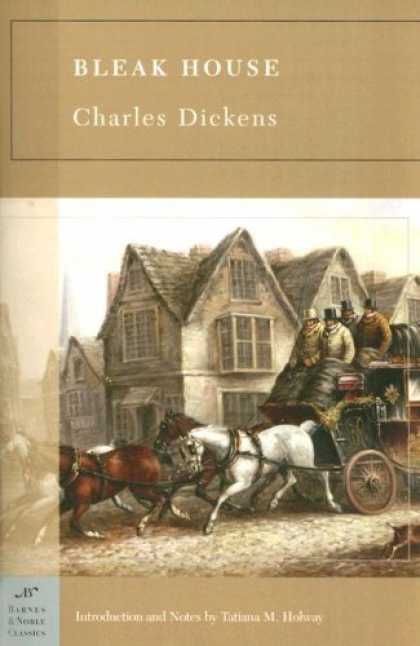
Bleak House by Charles Dickens


"What connexion can there have been between many people in the innumerable histories of this world, who, from opposite sides of great gulfs, have, nevertheless, been very curiously brought together!" (p. 220)
I have been reading Charles Dickens' books since long before I could fully appreciate them. Even though I didn't grasp the social commentary at a younger age, I have always loved the webs he weaves between and around his characters. By the end of each novel, everyone has had some influence on everyone else. The world seems a much smaller, more significant place after reading one of his works.

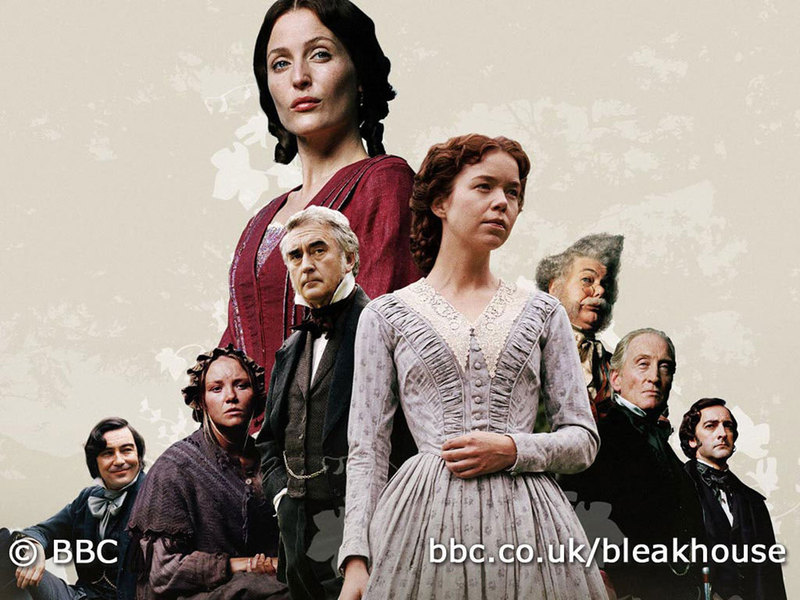
"His novels are full of energy and are teaming with life," says Andrew Davies, one of my favorite screenwriters (who incidentally did an incredible screen adaptation of this book) "I love the way he makes such a rich mixture of humour, tragedy, sentiment and social indignation. You get so many different things rolled up into one great book. He had such a vivid imagination and some of his characters are just extraordinary. Bleak House combines a terrific mystery with a series of love stores."
Dickens had a huge influence for good on society of the 1800's through his writing, and in this novel he focuses a great deal on the British Court of Chancery. Yet to me, the most interesting characters were those not directly involved with the "infamous" Chancery suit of Jarndyce and Jarndyce: I loved (and despised) Mrs. Jellyby, a woman intent on helping children a thousand miles away in Boorioboola-Gha, Africa, with several latch-key, unkempt children of her own. The married life of the sweet Bagnets, the "deportment" or Mr. Turveydrop, the awkward, muddling, good-hearted Mr. Guppy, and the poor street-sweep, Jo, were more interesting even than the main characters. This story is told from two completely different perspectives: chapters told by an all-knowing narrator who can see the end from the beginning (and drops several hints of it along the way), and the autobiographical chapters of Esther Summerson, the sweet and kind orphan girl who ends up blessing countless lives. His jumping back and forth between these two voices keeps the story interesting.

If you don't think you can handle the book (although you really should try!), you must at least watch the BBC version. Even those skeptical husbands out there (like my own) will like it for its mystery and suspense.

"The vast majority of the fastidious critics [of Dickens] have . . . never read Dickens at all; hence their opposition is due to and inspired by a hearty innocence which will certainly make them enthusiastic Dickensians if they ever, by some accident, happen to read him." -G. K. Chesterton

Sunday, May 9, 2010

Jane Austen Mystery Series by Stephanie Barron

Jane Austen--I love all of her books, each one more than the one I previously read, because each improves upon reading.  But sometimes I'm a little disappointed that she didn't live just a tiny bit longer . . .

So for someone who loves Jane Austen as much as I do, this series is a perfect goldmine.  It has been a while since I read them, (and there are two I haven't read yet) but I was completely enchanted by them.  Stephanie Barron has studied and perfected the voice of Jane Austen.  Based on a fictional "diary" found in a manor house years after her death, these books are a sort of record of her life in between her novel writing and letters to her sister and other family members.  Each one centers around some kind of mystery, some involving murder.  Barron includes a lot of actual instances and facts from Austen's life, and you travel with her on her real-life journeys, so you feel like the mysteries could actually have happened . . .

As I recall, these books are clean enough for older teenage readers and definitely recommended for any and all Jane Austen-fan grown-ups like myself!

Thursday, May 6, 2010

The Incorrigible Children of Ashton Place: The Mysterious Howling by Maryrose Wood

"All books are judged by their covers until they are read."
Such is the claim of Agatha Swanburn, founder of the Swanburn Academy for Poor Bright Females. The prize student from this school, Miss Penelope Lumley, is the governess and heroine of the story, and often refers to such "pithy kernels of truth," another being, "If it were easy to resist, it would not be called chocolate cake."

I tend to judge books by their covers. Even more so, I judge them by their "opening act"--the first page usually has to grab my attention and delight me, and this book was a winner on both counts. The cover has a macabre look to it, and the story was delightful. A young governess is sent to instruct three "incorrigible" children (which incidentally becomes their last name) on how to behave--but unfortunately they appear to have been raised by wolves, making her task difficult and hilarious. It was a sort of Jane Eyre for kids--minus Mr. Rochester and the romance--written with a voice not unlike a modern Jane Austen:

"As you may have already had cause to discover, a statement can be both completely true and completely misleading at the same time. This is called 'selective truth telling,' and it is frequently used in political campaigns, toy advertisements, and other forms of propaganda." (p. 166)

"If you have ever opened a can of worms, boxed yourself into a corner, ended up in hot water, or found yourself in a pretty pickle, you already know that life is rarely (if ever) just a bowl of cherries. It is far more likely to be a bowl of problems, worries, and difficulties. This is normal and you should not be alarmed." (p. 119)

Clean, fun, witty (and even mildly instructive about literature and poetry), this book makes a good read for young adults and adults alike. It has a cliffhanger ending, which luckily means there are more to come!

Saturday, April 3, 2010

The Missing: Found & Sent by Margaret Peterson Haddix


Definitely a fast, exciting read, I have had a lot of fun reading these books. Written at about a 6th grade level (give or take a grade . . .), they involve everything from time travel to history. I would highly recommend them for kids. They are clean and entertaining, and the second book even has a fair bit of English history in it. And Haddix--could you have a cooler last name as an author?

Tuesday, March 2, 2010

The City of Ember by Jeanne DuPrau


The city of ember is a great book about a city surrounded by darkness. The city's people believe that they are the only light in the dark world, except two kids named Lina Mayfleet and Doon Harrow. They find a secret tunnel and think they've found a way out of ember. Was ember an underground city? Did the passage they found lead to anything? You'll find out if you read the city of ember.

Friday, February 12, 2010

No. 1 Ladies Detective Agency by Alexander McCall Smith

If you haven't yet discovered this series, it's time you did. My wonderful Grandma Alma, who served two LDS missions to Africa, got me hooked on these books. Written (by a man, I might add!) from the perspective of Precious Ramotswe, a self-appointed female detective, they are set in Botswana, Africa.

What I love most about this series is the taste it gives you of every day life in Africa. From the beautiful style of speaking to the pumpkin soup and bush tea, each page contains little pearls of wisdom. The people are courteous (or at least expected to be so), life is slower, and there is a respect for humanity and nature that emanates from the pages. But it is far from boring! Each book has a key mystery to solve and several minor ones along the way, but you find yourself enjoying the culture and wisdom every bit as much as the mystery.

*Disclaimer: The very first book (and only the first--there are 10 all together) has a chunk in the middle that I remember being inappropriate--the only thing I've objected to in the whole series.


Here are all the books in the series (so far):

The No. 1 Ladies' Detective Agency
Tears of the Giraffe
Morality for Beautiful Girls
The Kalahari Typing School for Men
The Full Cupboard of Life
In the Company of Cheerful Ladies
Blue Shoes and Happiness
The Good Husband of Zebra Drive
The Miracle at Speedy Motors
Tea Time for the Traditionally Built
The Double Comfort Safari

How can you not love books with names like that?

Sunday, January 31, 2010

Ginger Pie by Elenor Estes


I liked this book because it's about a dog who gets captured by a mysterious man in a yellow hat, but eventually finds it's owner. I think that this is a cute and funny book.
(Jessica here--I loved reading this book out loud to Lydia. There were many parts where we laughed out loud--it was truly darling. And clean and cute and old-fashioned--not enough books like that anymore!)

LinkWithin

Related Posts with Thumbnails