Showing posts with label hefty novels for thinking. Show all posts

Tuesday, April 10, 2012

The Hunger Games Series by Suzanne Collins

It isn't every day that I am completely engrossed in a book.  I do my reading in snippets--a bit at the gym in the morning, some with my book propped up by a salt shaker while I eat lunch, etc.  Every once in a while I come across something I can't put down or read in bits and pieces.  With Harry Potter, I believe this was because the magical world J.K. Rowling created was so new and fascinating.  I can't think of anything since Harry Potter that has been so utterly gripping as The Hunger Games.


I was afraid to read these books--there is a lot of hype about them, and I have heard countless people tell me what they probably told you too: "The first one is great, the second is good too, but it doesn't end how you want it to . . . "  I have also been warned against the violence in the books.  And with good reason--these aren't stories for the faint of heart!


That said, I want to tell you why you should at least consider The Hunger Games series, if you haven't already read them like half of the reading world.


1. It's original. I mean, there are a lot of dystopian books out there, but none with such a believable, fascinating (albeit horrifying) premise.


2. The characters are believable.  No offense to the Twilight series, but Katniss is no Bella . . . I found myself really rooting for the main characters.

3. Yes, there was violence, but it wasn't the mindless killing I expected it to be. Katniss, the main character, regrets her part in any killing, and she makes a point of disagreeing with the entire Hunger Games. (I'm just assuming everyone knows the basic storyline here)


4. There was no mushy, inappropriate romance junk. I still wouldn't let anyone younger than 15-16 read it, just for the sake of the disturbing premise, but it was much more appropriate than the Twilight Books.  Ok, I'm afraid I'm going to get on my soapbox here for a minute . . .


Soapbox:  I am incredibly concerned about the youth of this decade being exposed to far too much intimacy through books like Twilight and the rest of that series.  They are so not appropriate for kids who are younger than . . . thirty, maybe?  Mostly the last one--far too much information about sexual matters.  And although they are written by a member of the same church I belong to, and even though the main characters are married--for heaven's sake, do we really need to know every private detail?  I believe books of this nature are porn in the form most tantalizing to young women.  Girls don't go around looking for pornography pictures; Satan knows he can snag women (young and old) through books and movies like Twilight.  I confess, I did read the series and watched the movies--the storyline is very interesting, but there is a real danger there you need to be aware of for young women.  Please be very careful with your young girls! Ok, I'm through.

5. Suzanne Collins can really write.  I think sometimes authors get in the way of their story--they write in an awkward way that never lets you forget you're reading a book.  In contrast, each one of these books draws you right in, and you're living the story with Katniss.  The first person voice isn't distracting at all, like others written in this style, and you forget you're reading.

6.  It provides very interesting food for discussion--is it possible for the world as we know it to become like Panem, this futuristic world?  What would you do if you were forced to join the Hunger Games?  Is war ever right?  You could have a great discussion with your kids about what type of government is really the best, as well as how the gospel of Jesus Christ can solve every social problem in the world.  I have heard the complaint that it doesn't teach a great moral lesson, but I beg to differ.

Now, about the individual books themselves: The Hunger Games could stand alone, if it weren't for the cliffhanger-ish ending.  It is powerful in and of itself, fascinating, and really well done.  Catching Fire is much the same, butI know people who have decided not to read Mockingjay because it's gotten a bad rap.  I submit that it is every bit as good as the other two books; while things don't end "happily ever after," the way Collins finishes it is absolutely brilliant, and she leaves you with a lot to mull over.

I have yet to see the movie, but I am very excited to give it a try.  I have heard good things.  So give the books a try if you are brave enough, and may the odds be ever in your favor!

Tuesday, February 7, 2012

Great Expectations by Charles Dickens

It is Charles Dicken's 200th birthday today.  I get a lump in my throat just thinking about the impact this man has had on my life and the lives of millions of others over the past two centuries.  No writer has done more (Shakespeare excepted, perhaps) to influence everything from the way our novels are written to how we celebrate Christmas.  And no book, aside from the Book of Mormon, thrills my whole soul like a good Dickens novel.  I remember summer library trips in my youth, where I would bee-line straight to the "D" aisle of our library.  There I would touch the spines of those beautiful old Dickens books, deciding which one to immerse myself in next.

Great Expectations was my initiation into the rich parlance of Charles Dickens.  I remember reading it just after Jane Eyre and liking it, although I'm sure I didn't understand half of it.  It has everything--mystery, humor, a dash of romance--but I believe the most important theme of the book is the impact our choices have on us.

I especially enjoyed reading it with Lydia.  She surprised me one day by looking through the bookshelves in my room (my room is my sanctum sanctorum--it houses my Victorian novels, Harry Potter, and all the Barnes & Noble Classics I've accumulated) and stating her intention to read a Dickens.  "Don't get too excited, Mom," she stipulated, "or I probably won't do it."  (I made that mistake with Anne of Green Gables, and I fear she'll never give those gems a try . . . *sigh*)  She raced ahead of me--she can read like the wind, and she comprehends everything.  I was overjoyed to hear her laugh out loud at Mr. Wopsle & Mr. Pumblechook--she got it!  She discovered Dickens's masterful humor!  I felt like she'd finally joined my personal Dickens Fan Club.  Here are her thoughts--if nothing else, she's honest!


I liked Great Expectations.  The ending was different from the way I expected, but it was good overall.  There were some pretty interesting characters.  Wemmick was one of my favorites because of his funny double-life.  It taught a good lesson about thinking about what you choose, because Pip made lots of decisions, but not all of them were good.  He was kind of hasty at making choices.


I think Charles Dickens is a great author.  Great Expectations wasn't my style, but I think that's because I am a younger girl.  The older you are, the closer you are to that time period, so I'd suggest it to older people.


Yes, thank you, Lydia.  And if you're an "older person," as I obviously am, and closer in years to the 1800's, the story of Great Expectations is probably familiar to you, with its themes of crime, broken promises, and ambition.  I have to agree with Lyd--Pip has never been my favorite character (he seems so weak!), but his choices made for some of the best discussions we have ever shared about books.  I mean, haven't we all let someone down?  Haven't we all wanted to be popular, neglecting loved ones and dear friends in the process?  I'm glad we now have this great classic to fall back on as Lyd nears the teenage years--I can refer to Pip for examples of what not to do.  And there are so many redeeming characters--Joe, Biddy, Herbert, Wemmick--who somehow help make Pip become the man he should be.  We treasure the Biddies and Joes in our lives, don't we?

Dickens is beloved to me for another reason--he offers mutual ground for Seth and I.  While Seth barely tolerates my Jane Austen "chick flick-ish" movies, he hasn't met a Dickens movie he didn't like--or at least one that didn't keep him intrigued.  He actually grew up on this version of Great Expectations, thanks to my wonderful Mother-in-Law, Elaine:
It's fantastic (although I always had issues with Estella seeming so much older than Pip), produced by Disney, and starring the great Anthony Hopkins as Magwitch.  Point of interest:  Miss Havisham is Jean Simmons, who plays Estella in the 1946 version.

I haven't been too interested in any other version, especially the risque 1998 version (Dickens must have rolled over in his grave)--however, the BBC has made a new one (2011) that looks very intriguing.  I love what Gillian Anderson, the new Miss Havisham, has to say about her role in the film, as well as the book itself:


"I can imagine that journey [reading Great Expectations] as a young kid, especially a young boy, must be unbelievably exciting.
"It was the journey pre-Harry Potter. Of course it was longer ago, but I can imagine young people having the same kind of magical response to Great Expectations that we did when Harry Potter books first started to come out.
"That's if it does get introduced at an early age, in school or through a parent or whatever and the child is able to crack the density of it." http://www.bbc.co.uk/blogs/tv/2011/12/great-expectations-gillian-anderson.shtml

I may shy away from the even newer version (2012) with Helena Bonham Carter, bless her creepy heart, as Miss Havisham.  We'll have to see.

Seth marvels that I can enjoy new versions of shows I have seen so many times before, but I'd like to think Dickens would be proud that his stories are so timeless.  So go ahead--celebrate his birthday with a wonderful book or movie, and I guarantee you'll thank me.

Friday, January 14, 2011

Tess of the D'urbervilles by Thomas Hardy

You have to prepare yourself if you're going to read this one.  I'm going to spoil everything for you and tell you that yes, it is a tragedy, and no, it doesn't end well (which is, I suppose, the definition of tragedy . . . ).  But somehow knowing that at the outset helped me, because I just had to keep reading to find out what would happen and how much worse it could get.   I could hardly put it down--and I'm afraid I ended up absolutely loving it!  And of course being completely frustrated with half the characters . . . I could actually sympathize with my husband's complaints of the lack of communication skills in my British movies.  I don't think I'll be showing him this one.

Like Dickens, I can see why Hardy felt compelled to write about the social ills of his day.  And like Dickens, I have to admit that Thomas Hardy is a wonderful author.  He gets into the minds of the characters so thoroughly--the hardest thing for me was that he kept saying, "Had he said such-and-such, she never would have etc. etc. etc."  All the more tragic!  I admit that I wept for Tess more than once (and once at the gym--why do I always hit the sad parts while I'm exercising?).  Although this book was originally met with outrage, I thought it taught a very poignant lesson about purity, chastity, and respect for women--one that at the time was much-needed and is probably needed even more today.

Wednesday, January 12, 2011

The Picture of Dorian Gray by Oscar Wilde

I'm on a classics kick, as you'll begin to notice.  My amazing mother is teaching English for an England study-abroad program this spring, and has enlisted my voracious reading appetite in tackling her long list of required books.  It's a fun excuse to read my head off!

I started with The Picture of Dorian Gray because I bought a copy at the grocery store for $1--and because it was fairly short.  Years ago I saw the black & white version, but the book is much, much better.

This is Oscar Wilde's sole novel--I didn't realize it, but his other writings were only plays or essays.  And you can tell--his dialogue reads very much like a play, the characters playing verbal tennis as they toss their comments back and forth.  These are followed by long (some of them quite long) descriptions.  But still, it is a book that keeps you reading, and Wilde is quite good at invoking reflection.

His play The Importance of Being Earnest is one of my favorites.  One of the main characters in the novel (Lord Henry Wotton) reminded me quite a bit of Algernon Moncrieff--both characters say things they don't mean--things to shock "society."  Often then say the opposite of what is reasonable, but the great difference is that Algy says them in jest, while Lord Wotton says them specifically to tempt Dorian Gray into wrongdoing.  While Wilde never comes straight out with a moral--in fact, at times he seems to be agreeing with the villains--the book teaches a definite lesson.  I think it would be a great book for teens to read with parents and discuss (have I pushed that enough?).

Thursday, September 30, 2010

Gilead by Marilynne Robinson

We are reading this book for our book club, and I admit I wasn't very excited about it.  The name sounded quite forbidding and sermonizing somehow, and as I thumbed through the pages, I saw little or no dialogue.  But since it is a Pulitzer Prize winner, I thought I'd better give it a sporting chance.


And I am so glad I did!  Both reflective and inspiring, but with a good story line (yes, it does have a story, even without the dialogue!) it wasn't preachy like I suspected.  Ironically enough, it is the fictional autobiography of a preacher in Gilead, Iowa, nearing the end of his life.  As he writes to the son who will not remember him, he discovers that even in old age there is much to learn.  It is so beautifully written!  Marilynne Robinson's writing style kept reminding me of C.S. Lewis in his more serious books (i.e. Mere Christianity, etc.).  No swearing that I can recall, and nothing inappropriate or risqué.


It was one of those books that made me contemplate how I treat others and what I judge them by.  It seemed to go right along with our prophet's words from the General Relief society meeting last weekend:


"Mother Teresa, a Catholic nun who worked among the poor in India most of her life, spoke this profound truth: 'If you judge people, you have no time to love them.' . . . I ask: can we love one another, as the Savior has commanded, if we judge each other? And I answer—with Mother Teresa: no, we cannot. . . .I have in mind the charity that impels us to be sympathetic, compassionate, and merciful, not only in times of sickness and affliction and distress but also in times of weakness or error on the part of others."


I hope you find time to read and enjoy this one!  And  Pres. Monson's talk too, if you have the chance!

Thursday, August 12, 2010

North and South by Elizabeth Gaskell

I don't know if it's because I watched this movie a few years back and loved it or whether it's because I'm so in love with Victorian novels, but I couldn't put this down.  Literally.  At 11:30 one evening Seth turned to me (he was watching the news while I was sitting by him, engrossed in the romance between Mr. Thornton and Margaret . . .) and he said, "Honey, I just need you to really be with me for a minute.  Do you think you could put the book away?"

What Seth failed to appreciate is that in contrast with the Jane Austen books (I am NOT dissing them, by the way--they are my favorites!), the hero has an actual job (Seth's biggest issue with my "British movies").  John Thornton, a working-class, self-made man falls in love with Margaret Hale--not your typical beauty, but a strong personality and very interesting character from Southern England.

What makes this book so beautiful and intriguing is the Elizabeth Bennett/Mr. Darcy nature of their relationship.  I enjoyed watching the characters unfold and grew to like them more as I read.  It's not quite a Jane Austen, but on the whole I think you'll enjoy it if you like her romances.  Elizabeth Gaskell has such an approachable style to her writing--it's not intimidating or overly verbose, and she paints only the picture she needs to without leaving out details, but also without cramming them down your throat.
And if you don't get around to reading the book, you ought to at least give the BBC movie version a try.  It is absolutely beautifully done--almost better than the book--and the casting couldn't be better.  And I love the theme music!  I think I've just talked myself into watching it again . . . anyone up for a girls' night?

Friday, July 9, 2010

The Great and the Terrible Series by Chris Stewart

This was a very interesting series. Now, I am not an LDS fiction reader, but this came highly recommended from a friend, and although I didn't love it, I'm not sorry I read it.  It's about a group of the noble and great spirits who make their way through life during the last days of the world.
Likes:  It really made me think about how Satan works (sort of put me in the same mindset as reading C.S. Lewis's "The Screwtape Letters"--only that's a completely different book--and such a good one--maybe I'll re-read it!).  The first book takes place in the author's rendition of the pre-existence, where you get to know the main characters of the series.  Good dialogue, good writing style, and the guy definitely knows his military stuff.

Dislikes:  It's definitely packed with action and a bit too much blood and gore for my taste.  I don't like reading about people's brains getting blown out, etc--maybe if I were a guy I would have liked it more.  Also, the whole adversary and devil's helpers thing started to scare me a bit.  And all the evil that leads up to the end of the world was just too much for me.  I'm afraid I did a lot of skimming through so I could get to the end and find out what happens.  The first and last books were my favorites.

If you are interested and want to know more, DeseretBook.com has a great review summing up the entire series.

Wednesday, June 9, 2010

Roots by Alex Haley

"It begins with a birth in 1750, in an African village; it ends seven generations later at the Arkansas funeral of a black professor whose children are a teacher, a Navy architect, an assistant director of the U.S. Information Agency, and an author. The author is Alex Haley. This magnificent book is his."

So states the back cover write-up of this magnificent book--doesn't it just give you the chills?My good friend Taryn, when I told her I hadn't read it before, told me I simply had to read it. I had seen the TV series with I was little and remembered it as being quite troubling. But I think it deserves to be read.

As I read it, I thought so much of my own family history, of our nation's history, of resiliency of the human soul, and of the human need to pass on to our children the things that we know. After so much struggle, heartache, love, and perseverance, when I read the final chapter of the book where the author himself comes into the story, I couldn't hold back the tears. Life is truly beautiful!

*Disclaimer: You should know (and probably do) that this book deals quite graphically with slavery and all its horrors. There are brutal beatings and wicked slave masters . . . I won't go on, but there were a couple of parts I skimmed over. Yet I still feel it is such an important book that it's worth reading--if it wasn't, I probably wouldn't have posted it!

Friday, May 28, 2010

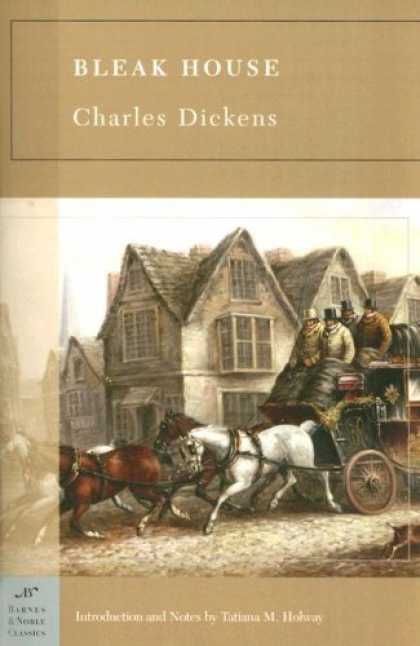
Bleak House by Charles Dickens


"What connexion can there have been between many people in the innumerable histories of this world, who, from opposite sides of great gulfs, have, nevertheless, been very curiously brought together!" (p. 220)
I have been reading Charles Dickens' books since long before I could fully appreciate them. Even though I didn't grasp the social commentary at a younger age, I have always loved the webs he weaves between and around his characters. By the end of each novel, everyone has had some influence on everyone else. The world seems a much smaller, more significant place after reading one of his works.

"His novels are full of energy and are teaming with life," says Andrew Davies, one of my favorite screenwriters (who incidentally did an incredible screen adaptation of this book) "I love the way he makes such a rich mixture of humour, tragedy, sentiment and social indignation. You get so many different things rolled up into one great book. He had such a vivid imagination and some of his characters are just extraordinary. Bleak House combines a terrific mystery with a series of love stores."
Dickens had a huge influence for good on society of the 1800's through his writing, and in this novel he focuses a great deal on the British Court of Chancery. Yet to me, the most interesting characters were those not directly involved with the "infamous" Chancery suit of Jarndyce and Jarndyce: I loved (and despised) Mrs. Jellyby, a woman intent on helping children a thousand miles away in Boorioboola-Gha, Africa, with several latch-key, unkempt children of her own. The married life of the sweet Bagnets, the "deportment" or Mr. Turveydrop, the awkward, muddling, good-hearted Mr. Guppy, and the poor street-sweep, Jo, were more interesting even than the main characters. This story is told from two completely different perspectives: chapters told by an all-knowing narrator who can see the end from the beginning (and drops several hints of it along the way), and the autobiographical chapters of Esther Summerson, the sweet and kind orphan girl who ends up blessing countless lives. His jumping back and forth between these two voices keeps the story interesting.

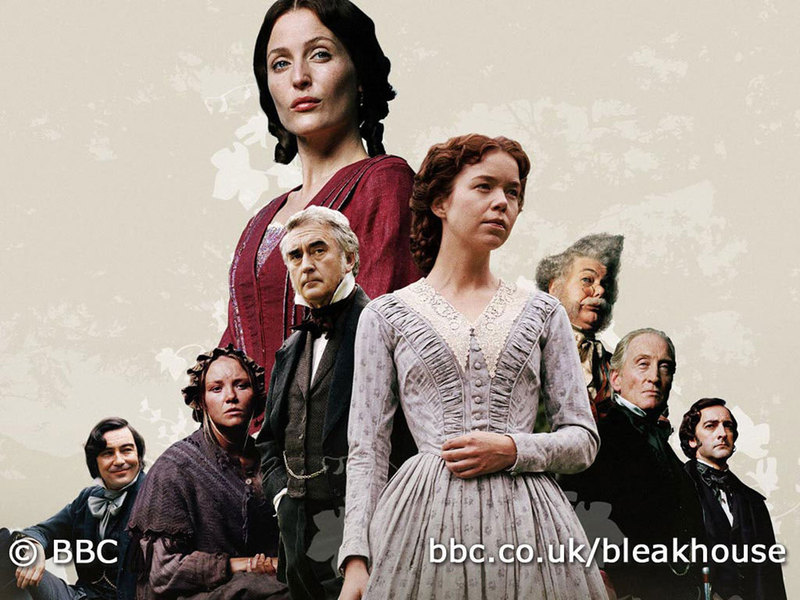
If you don't think you can handle the book (although you really should try!), you must at least watch the BBC version. Even those skeptical husbands out there (like my own) will like it for its mystery and suspense.

"The vast majority of the fastidious critics [of Dickens] have . . . never read Dickens at all; hence their opposition is due to and inspired by a hearty innocence which will certainly make them enthusiastic Dickensians if they ever, by some accident, happen to read him." -G. K. Chesterton

Sunday, May 9, 2010

The Help by Kathryn Stockett

I love reading a book that I'm sorry to finish.  Usually books that fall into that category are the classics, like a good Jane Austen or Charles Dickens.  In fact, it used to be that I didn't trust modern writers to come up with anything half as good.  But I absolutely loved this book, in spite of its being a national bestseller (and it looks like they're making it into a movie).  It's just about perfect for a book club (luckily that's how I was introduced; I don't often read books unless they come highly recommended by people I trust!).

Set in Jackson, Mississippi, in the midst of the Civil Rights movement, surrounded by Jim Crow laws, lynchings, and all kinds of racial issues, this novel explores the lives of two types of women; the white women of "society" and the black "help" they employ.  Stockett unfolds the experiences of three strong women; Skeeter Phelan, a white girl raised on a plantation, and Aibileen and Minny, two maids to her white friends.

Kathryn Stockett writes this book from three different and distinct viewpoints, reminiscent of Barbara Kingsolver's style in The Poisonwood Bible.  I couldn't pinpoint one I looked forward to hearing from the most--each had a lovable personality and faults a-plenty.  Perhaps that's what makes this story was so real and human.

I must warn you that it does have some swearing; not every-other-word or anything, but enough to discourage me from ever hearing it on tape . . . and there is a chapter with a "flasher" (I don't know how to put it more delicately) that I thought could have been left out.  But I still think it's a beautiful story well worth reading.

Wednesday, March 31, 2010

How Green Was My Valley by Richard Llewellyn

From the very first page of this book, I was gripped by the beautiful Welsh voice of the narrator--you find yourself thinking with a lilt.  The whole book just felt green.  I don't mean eco-friendly green--just lush and beautiful, like the fields of England I miss so much.


The narrator, Huw Morgan (never quite sure how to pronounce that . . . Hugh? How? . . .), reflects on his life, beginning with his childhood.  Even though they go through trial after trial, their simple faith and strength are inspiring.   I almost felt it could be the tale of my own ancestors.
***Disclaimer: I hate how some of the best books have to have these!  In the "coming-of-age" portion of Huw's life, he gets way too involved with a young lady.  I skipped several paragraphs, so I honestly don't know exactly how graphic it was, but what I read was too much for me.  The only dog poop in the cinnamon roll, as my mother would say . . . still, I think the rest of the book is well worth reading if you are forewarned, and now you have been.

Wednesday, February 17, 2010

Book Review of The Poisonwood Bible by Barbara Kingsolver


I was surprised by how much I loved this book. A missionary family (a controlling, bible-thumping minister, his wife and four daughters) embarks on a journey deep into the heart of the Congo. Beautifully written, Kingsolver uses the very distinct voices of each daughter to tell the story of their experiences. The entire novel is almost poetic, and although there were parts I didn't love (some of the end gets a bit slow), I found myself anxious to see what the next chapter would contain. I've never read a book so tapestry-like, with each chapter as a thread. We read this for our book club, and I think it's a great novel for that type of setting.

Friday, February 12, 2010

Daniel Deronda by George Eliot


This is a book that is perhaps not for everyone, but I found it incredibly fascinating. I don't agree with George Eliot's personal life, but her books are suprisingly moralistic. She delves deeply into human character and portrays all walks of life--well, of English life, but then that's my favorite . . .

Eliot (whose real name was Mary Anne Evans) wrote this as her final novel. She touches on some pretty serious issues prevalent in late 1800's England: the treatment of Jews in society, the position of women, and the social standing of illigitimate children. It takes a while to read, and if you don't have the time, then can I beg you to watch the excellent movie version? It is very well-done by my favorite screenwriter, Andrew Davies (who has the 6-hour Pride & Prejudice, Little Dorrit, and many other beautiful movies to his credit), and stars a talented cast. Davies always follows the books closely, so it's almost as good as reading it. Almost . . .

LinkWithin

Related Posts with Thumbnails