Tuesday, February 7, 2012

Great Expectations by Charles Dickens

It is Charles Dicken's 200th birthday today.  I get a lump in my throat just thinking about the impact this man has had on my life and the lives of millions of others over the past two centuries.  No writer has done more (Shakespeare excepted, perhaps) to influence everything from the way our novels are written to how we celebrate Christmas.  And no book, aside from the Book of Mormon, thrills my whole soul like a good Dickens novel.  I remember summer library trips in my youth, where I would bee-line straight to the "D" aisle of our library.  There I would touch the spines of those beautiful old Dickens books, deciding which one to immerse myself in next.

Great Expectations was my initiation into the rich parlance of Charles Dickens.  I remember reading it just after Jane Eyre and liking it, although I'm sure I didn't understand half of it.  It has everything--mystery, humor, a dash of romance--but I believe the most important theme of the book is the impact our choices have on us.

I especially enjoyed reading it with Lydia.  She surprised me one day by looking through the bookshelves in my room (my room is my sanctum sanctorum--it houses my Victorian novels, Harry Potter, and all the Barnes & Noble Classics I've accumulated) and stating her intention to read a Dickens.  "Don't get too excited, Mom," she stipulated, "or I probably won't do it."  (I made that mistake with Anne of Green Gables, and I fear she'll never give those gems a try . . . *sigh*)  She raced ahead of me--she can read like the wind, and she comprehends everything.  I was overjoyed to hear her laugh out loud at Mr. Wopsle & Mr. Pumblechook--she got it!  She discovered Dickens's masterful humor!  I felt like she'd finally joined my personal Dickens Fan Club.  Here are her thoughts--if nothing else, she's honest!


I liked Great Expectations.  The ending was different from the way I expected, but it was good overall.  There were some pretty interesting characters.  Wemmick was one of my favorites because of his funny double-life.  It taught a good lesson about thinking about what you choose, because Pip made lots of decisions, but not all of them were good.  He was kind of hasty at making choices.


I think Charles Dickens is a great author.  Great Expectations wasn't my style, but I think that's because I am a younger girl.  The older you are, the closer you are to that time period, so I'd suggest it to older people.


Yes, thank you, Lydia.  And if you're an "older person," as I obviously am, and closer in years to the 1800's, the story of Great Expectations is probably familiar to you, with its themes of crime, broken promises, and ambition.  I have to agree with Lyd--Pip has never been my favorite character (he seems so weak!), but his choices made for some of the best discussions we have ever shared about books.  I mean, haven't we all let someone down?  Haven't we all wanted to be popular, neglecting loved ones and dear friends in the process?  I'm glad we now have this great classic to fall back on as Lyd nears the teenage years--I can refer to Pip for examples of what not to do.  And there are so many redeeming characters--Joe, Biddy, Herbert, Wemmick--who somehow help make Pip become the man he should be.  We treasure the Biddies and Joes in our lives, don't we?

Dickens is beloved to me for another reason--he offers mutual ground for Seth and I.  While Seth barely tolerates my Jane Austen "chick flick-ish" movies, he hasn't met a Dickens movie he didn't like--or at least one that didn't keep him intrigued.  He actually grew up on this version of Great Expectations, thanks to my wonderful Mother-in-Law, Elaine:
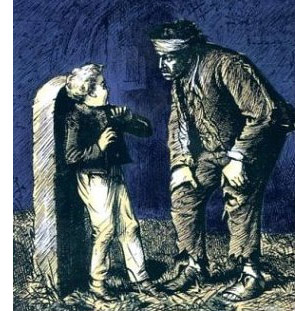
It's fantastic (although I always had issues with Estella seeming so much older than Pip), produced by Disney, and starring the great Anthony Hopkins as Magwitch.  Point of interest:  Miss Havisham is Jean Simmons, who plays Estella in the 1946 version.

I haven't been too interested in any other version, especially the risque 1998 version (Dickens must have rolled over in his grave)--however, the BBC has made a new one (2011) that looks very intriguing.  I love what Gillian Anderson, the new Miss Havisham, has to say about her role in the film, as well as the book itself:


"I can imagine that journey [reading Great Expectations] as a young kid, especially a young boy, must be unbelievably exciting.
"It was the journey pre-Harry Potter. Of course it was longer ago, but I can imagine young people having the same kind of magical response to Great Expectations that we did when Harry Potter books first started to come out.
"That's if it does get introduced at an early age, in school or through a parent or whatever and the child is able to crack the density of it." http://www.bbc.co.uk/blogs/tv/2011/12/great-expectations-gillian-anderson.shtml

I may shy away from the even newer version (2012) with Helena Bonham Carter, bless her creepy heart, as Miss Havisham.  We'll have to see.

Seth marvels that I can enjoy new versions of shows I have seen so many times before, but I'd like to think Dickens would be proud that his stories are so timeless.  So go ahead--celebrate his birthday with a wonderful book or movie, and I guarantee you'll thank me.

Saturday, January 21, 2012

The 2 1/2 Pillars of Wisdom Series by Alexander McCall Smith (Portuguese Irregular Verbs)


Have you read The No. 1 Ladies' Detective Agency series yet?  You really must.  And then after you do (because I think it helps to fall head-over-heels-in-love with the brilliant Alexander McCall Smith first), you have to reserve a few short days to read this series, The 2 1/2 Pillars of Wisdom.  It includes Portuguese Irregular Verbs, The Finer Points of Sausage Dogs, and At the Villa of Reduced Circumstances.

Each book follows the mundane life of the socially awkward German professor, Dr. Moritz-Maria von Iglefeld, whose sole accomplishment was to publish Portuguese Irregular Verbs.  He finds himself in all kinds of embarrassing situations, although of course he is never to blame.

Although lacking the depth of the Ladies' Detective Agency series (McCall Smith is still at his best when writing from a woman's point of view), these are still absolutely brilliant.  The illustrations are simple, the stories quite ordinary, and the books very short (each one 120-ish pages).  They won't take up too much of your time, but are definitely worth every smile they put on your face.

Friday, September 23, 2011

Book review of The Big Wave by Pearl S. Buck

I like to read to my kids during lunch--it seems to be a good time because their mouths are full of food, their hands are busy, and they're all sitting at the counter facing me.  It's hard to get them to sit still otherwise . . . This book was one we read together over the summer, just because I happened to have it on my bookshelf. I can't think where I got it--probably from my good mother, who first introduced me to Pearl S. Buck.  I highly recommend almost all of her books--I went through a Pearl S. Buck phase in high school and read everything our library had to offer.

This book is shorter than her others and written for younger readers.  It tells the simple story of two boys whose lives are influenced by the ocean, particularly by a "big wave," or tsunami, as we know it.  It seems like there are natural disasters all over the place nowadays (the last days are truly upon us, aren't they?), and reading this provided a good backdrop for us to discuss why Heavenly Father allows natural disasters to happen, why people die, and what happens to them when they die.  They really identified with the boys in the story, and I think that's due to Pearl Buck's writing style.  We're reading her book The Story Bible now, and it's really making the Bible stories come alive--I will keep you posted on that one!

Wednesday, July 13, 2011

Book Review of Watership Down by Richard Adams


If we were to tell you that this book is about a bunch of rabbits trying to find a new home, would you be very interested?  Probably not.  Yes, it is about a bunch (or to be technically correct, a warren, nest, colony, bevy, bury, drove, or trace) of rabbits; however, it is much more than that.  Driven out of their home by humans, Hazel, Fiver, and several other rabbits embark on a journey to find a new warren.  It is not so much like Charlotte's Web as it is like The Lord of the Rings--it is very interesting and exciting.  The rabbits have such distinct personalities, and their adventures are quite realistic.  While the end does get a little bit slow for a minute, don't give up--it picks up, and it's worth your time.  Both Lydia and Jessica highly recommend it--probably best for those age 10 & up.

Friday, July 1, 2011

Book review of Animal, Vegetable, Miracle by Barbara Kingsolver

The term "tree-hugger" has always carried a somewhat negative connotation for me--it brings to mind hippies living in tents or rallies to "save the spotted turtle!"  Forgive me if you are yourself a tree-hugger, but there you have it.  So I assumed that was what I was in for when our book club decided to read this.  Plus it's non-fiction, not my favorite category . . . but I was willing (reluctantly) to have a go--for Barbara Kingsolver's sake, since I loved her fascinating book, The Poisonwood Bible.

Would it be too trite to say this book changed my life?  Okay, maybe not quite that, but it has changed my thinking about food--probably forever, and I think for the better.  In the author's own words, here is the gist of the book:

"At its heart, a genuine food culture is an affinity between people and the land that feeds them.  Step one, probably, is to live on the land that feeds them, or at least on the same continent, ideally the same region.  Step two is to be able to countenance the ideas of 'food' and 'dirt' in the same sentence, and three is to start poking into one's supply chain and learn where things are coming from.  In the spirit of this adventure, our family set out to find ourselves a real American culture of food, or at least the piece of it that worked for us, and to describe it for anyone who might be looking for something similar.  This book tells the story of what we learned, or didn't; what we ate, or couldn't; and how our family was changed by one year of deliberately eating food produced in the same place where we worked, loved our neighbors, drank the water, and breathed the air.  It's not at all necessary to live on a food-producing farm to participate in this culture.  But it is necessary to know such farms exist, understand something about what they do, and consider oneself basically in their court.  This book is about those things." p. 20
Barbara Kingsolver literally takes you home with her--home to her family's little farm in Virginia, where she gives you a glimpse of their life during each month of this "locavore" (eating local & homegrown foods) experiment.  But she doesn't stop there.  She opens your eyes about the real dangers of the processed, industrial foods we are eating every day.  That is all fine and good, but what I loved the most was her emphasis on connecting with your family--on making mealtime a gathering time--both in eating and in meal preparation.  It rings true to me and reminds me of what Sister Julie Beck said recently about our families:

"Live in your home so that you’re brilliant in the basics, so that you’re intentional about your roles and responsibilities in the family. Think in terms of precision not perfection. If you have your goals and you are precise in how you go about them in your homes, youth will learn from you. They will learn that you pray, study the scriptures together, have family home evening, make a priority of mealtimes, and speak respectfully of your marriage partner. Then from your example the rising generation will gain great hope." (Julie B. Beck, "Teaching the Doctrine of the Family," Ensign, Mar. 2011, emphasis added)

Kingsolver speaks of the joys of holidays because of the food--and how that's not a bad thing, contrary to the popular dieting fads of today:

". . . [M]ost of America's excess pounds were not gained on national holidays.  After a certain age we can't make a habit of pie, certainly, but it's a soul-killing dogma that says we have to snub it even on Thanksgiving. . . . Planning complex, beautiful meals and investing one's heart and time in their preparation is the opposite of self-indulgence.  Kitchen-based family gatherings are process-oriented, cooperative, and in the best of worlds, nourishing and soulful.  A lot of calories get used up before anyone sits down to consume.  But more importantly, a lot of talk happens first, news exchanged, secrets revealed across generations, paths cleared with a touch on the arm.  I have given and received some of my life's most important hugs with those big oven-mitt potholders on both hands." p. 288

From a literary standpoint, Barbara Kingsolver has such a way with words!  She is like unto Alexander McCall Smith--you find that when you end one of her chapters, she has somehow come full-circle with its introduction. You'll have to give the book a try to see what I mean.  And if you'd rather just browse through her delicious recipes, check out the book's website.  Overall, I walked away from Animal, Vegetable, Miracle with renewed desire to make our family mealtime something special and purposeful.

Thursday, June 16, 2011

The Magic Thief Series by Sarah Prineas


          I absolutely loved this book!  It had plenty of mystery, fantasy, and adventure.  It's kind of like Harry Potter, in the way that it has magic and wizards--just no wands.  I liked the way the author described everything. It's one of my favorites.

Friday, May 27, 2011

Founding Brothers: The Revolutionary Generation by Joseph J. Ellis


My good friend Jera brought this book over--somehow she ended up with two copies.  I can't think of the last time (if ever) I have read a whole book about our Founding Fathers, although I always have the best of intentions--I have a few of them on my "to-read" list on Goodreads . . . Since this one wasn't too thick (which is what usually scares me away from historical books or biographies), I decided to give it a try.  So glad I did--this one really got me thinking about our founding fathers and their contributions to the life we live today, as well as how far we have strayed as a nation from some of their original ideals.

Taking sort of a back-door approach, Ellis looks at some less-written-about episodes or aspects in the lives of Washington, Jefferson, Franklin, Adams, Madison, Hamilton, and Burr (i.e. unlikely friendships, Washington's farewell address, the duel between Hamilton & Burr) and uses them to paint a picture of what things must have really been like for these amazing men.  He does make a lot of assumptions, which troubled me at times, but he is a beautiful narrator; never once did I feel bored with it.  There were several moments during my reading when I was disenchanted with these great men, but just as I thought Ellis was going to knock them off my personal pedestal, he came full circle and restored my faith in their inspiration.  Well, maybe not Aaron Burr so much . . .

So yes, I would highly recommend it as a springboard to heftier historical or political reading. It has inspired me to attack John Adams by David McCullough.  Do you think I can handle it?

Wednesday, May 11, 2011

Poetry by Douglas Florian

My kids and I stumbled upon a treasure--the poetry of Douglas Florian.  I confess I am not much of a poet enthusiast, and usually I don't understand much of it.  But children's poetry is another story--I remember spending hours devouring Shel Silverstein.  So I was delighted to discover Douglas Florian and his whimsical, playful style.  My kids memorized this one, they got such a kick out of it!  It's from Lizards, Frogs, and Polliwogs:


It's wise to stay clear
Of the dangerous cobra
All months of the year,
Including Octobra.


My personal favorite is "The Praying Mantis" from Insectlopedia:


Upon a twig
I sit and pray
For something big
To wend my way:
A caterpillar,
Moth,
Or bee--
I swallow them
Religiously.
His humorous artwork adds to each poem, and my kids like the fact that he paints with watercolor on paper bags.  Florian says this of his own work: "My drawings are abstract regressionist. They are old but behave like little children."  Apparently he has published several children's poetry books--can't wait to get my hands on them!

Monday, April 25, 2011

Jane Eyre by Charlotte Bronte

I have read Jane Eyre probably more than any book aside from the Book of Mormon and the New Testament. I love it so much, I worry that I won't do it justice!  It is definitely one of my top five all-time favorites.  It has been made into I don't know how many films, and even a Broadway play with a beautiful soundtrack.
I'm sure almost everyone is familiar with the story of Jane Eyre--plain, ordinary young lady becomes a governess and falls in love with her gruff employer . . . the plot seems fairly boring, but I LOVE IT!  And I know I'm not alone.  What exactly makes it so universally appealing?  


Well, here's what I love about Jane Eyre:
1. Jane herself tells the story, and she addresses you directly as "dear reader" several times, which pulls you in and makes you sympathize with her all the more.  You feel like you're a friend she's confiding in.
2. The love story is perhaps the most beautiful ever written--especially because it's between two such unlikely characters.  Neither is very alluring, per se, but their romance manifests a "marriage of true minds," as Shakespeare would say.
3. Mr. Rochester--he is just the perfect hero!  Actually not perfect--he has his flaws, but they make him that much more likeable.
4. It is just so well-written!  The dialogue is anything but dry or forced, and the narration flows so beautifully!
5.  Each character you become closely acquainted with is deep and passionate.
6. Perhaps what I like the most is that Jane isn't perfect.  She has a bit of a temper and is also tempted--but she has a firm conviction in what she knows is right.


There is so much food for discussion!  Jane's moral courage; Mr. Rochester's desire to begin a new life, yet falling into the same old habits; Jane's ability to rise above her surroundings and make the most of things--they just don't make books this cut and dried anymore!


Jane Eyre was even worthy of mention on this last General Conference--I was thrilled to hear Sister Ann M. Dibb say the following:  


One of my favorite books is the British classic Jane Eyre, (Hooray--we can be friends!) written by Charlotte Brontë and published in 1847. The main character, Jane Eyre, is a penniless, teenage orphan who exemplifies what it means to be true. In this fictional account, a man, Mr. Rochester, loves Miss Eyre but is unable to marry her. Instead, he begs Miss Eyre to live with him without the benefit of marriage. Miss Eyre loves Mr. Rochester as well, and for a moment she is tempted, asking herself, “Who in the world cares for you? or who will be injured by what you do?”


Quickly Jane’s conscience answers: “I care for myself. The more solitary, the more friendless, the more unsustained I am, the more I will respect myself. I will keep the law given by God. … Laws and principles are not for the times when there is no temptation: they are for such moments as this. … If at my individual convenience I might break them, what would be their worth? They have a worth—so I have always believed. … Preconceived opinions, foregone determinations, are all I have at this hour to stand by: there I plant my foot.”
In a desperate moment of temptation, Jane Eyre was true to her beliefs, she trusted in the law given by God, and she planted her foot in resistance to temptation.
Being true to our beliefs—even when doing so isn’t popular, easy, or fun—keeps us safely on the path that leads to eternal life with our Heavenly Father. ... Being true also allows us to have a positive effect on the lives of others. 
And that, I think, is what I like the most about Jane Eyre--the way her righteous choices influence the lives of others.
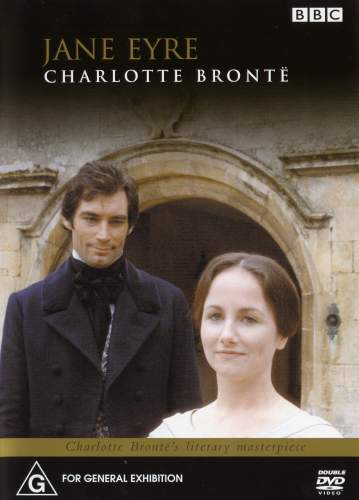
Now, I am quite partial to the movie versions of this wonderful classic, my favorites being the one starring Timothy Dalton
and the 2006 version starring Toby Stephens & Ruth Wilson.  I never get tired of watching this one--it is so well-done!
And, if you're as big a fan as I am, you will probably be eager to see the newly released 2011 version!  It looks good--a little dark and probably condensed to fit the typical 2-hour Hollywood length, but you really can't go too far wrong with Jane Eyre, can you?  
(Also, J.E. fans will enjoy this interesting comparison between the many movie-version Mr. Rochester's.)

Thursday, April 21, 2011

Alice's Adventures in Wonderland & Through the Looking-Glass by Lewis Carroll

Jessica:  Having grown up watching Disney's cartoon version of Alice in Wonderland and now watching it with my own children, I have always had a soft spot in my heart for these stories.  I loved reading them as a pre-teen.  However, after watching the new Disney version by Tim Burton (it was very . . . interesting, to say the least), I had to re-read them to make sure they weren't more bizarre than I recalled.  They may be a bit off-the-wall, but not so outlandish as the movie would lead you to believe; in fact, both books were quite comical and had me laughing out loud.

Carroll was a master at language and logic--he actually worked as a mathematics tutor at Oxford, and you can tell that he had a brilliant mind.  He uses word play frequently in his stories, which makes them all the more amusing.  Both books are very clever and entertaining and well-deserving of the title "classics."

Alice's Adventures in Wonderland has the stories of the Mad Hatter & March Hare and the Queen of Hearts.  Through the Looking-Glass deals more with the chess pieces--the white and red queens--and traveling from one "square" of a giant chessboard to another. It includes the characters of Tweedle-dum and Tweedle-dee and the talking flowers.
Alice with Tweedle-Dum & Tweedle-Dee before their battle
Lydia:  I loved the royal subjects and how they acted. For example, how the Red Queen is running with Alice and they get absolutely nowhere. Then there is the White Queen who starts crying because she will get hurt in the future. I loved these books in every way!
Alice talking with the White Queen
(I suppose I am biased, but I love Lydia's drawing style!  I made her sketch a couple of her favorite scenes so I could show her off a bit . . . :)

LinkWithin

Related Posts with Thumbnails